Lymph Savior ingredients: the full list of botanicals, and what each one is really for
By the LymphSavior Editorial Team · Updated 3 September 2026 · about 9 min read
The ingredients list is the only part of a lymphatic supplement that is checkable. Marketing copy can say anything; the panel on the bottle cannot. This page sets out every botanical named on the Lymph Savior pack, the three extra plants that appear on an older manufacturer graphic, and — ingredient by ingredient — what human research actually supports. We are an independent affiliate publisher, so we have written this the way we would want it written for us: names first, evidence second, and the gaps stated plainly.
What are the ingredients in Lymph Savior?
Lymph Savior lists six botanicals on its current pack: red clover extract, horse chestnut extract, burdock root, yerba mate, ginger root and echinacea. It is sold as capsules only — 60 capsules and 30 servings per bottle, two capsules a day — and no per-capsule milligram amount is published for any ingredient, so the Supplement Facts panel on the bottle you receive is the authority.
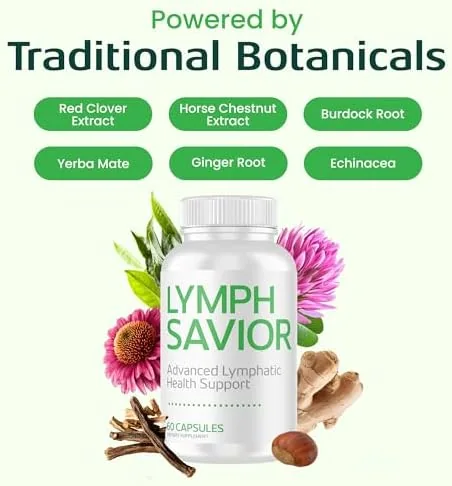
The full Lymph Savior ingredients list at a glance
The table below is the whole label in one view. The right-hand column is the honest part: how much published human research exists for that plant, judged on trials in people rather than test-tube work, and judged for the plant on its own rather than for this finished blend, which has never been trialled.
| Botanical | Botanical name | Why it is in a lymphatic formula | Human evidence for that plant |
|---|---|---|---|
| Red clover extract | Trifolium pratense | Traditional “blood cleansing” and skin herb, rich in isoflavones | Trials exist, but almost entirely for menopausal symptoms — not lymph |
| Horse chestnut extract | Aesculus hippocastanum | Standardised seed extract, active constituent aescin, used for heavy legs | Strongest here: Cochrane-reviewed for chronic venous insufficiency |
| Burdock root | Arctium lappa | Classic cleansing root in Western and East Asian herbal traditions | Extensive laboratory work; human detox trials essentially absent |
| Yerba mate | Ilex paraguariensis | Polyphenol-rich leaf, the antioxidant contributor — and naturally caffeinated | Reviewed for antioxidant and metabolic effects; nothing lymph-specific |
| Ginger root | Zingiber officinale | Digestive comfort and circulation, a well-studied culinary botanical | Good trial base, mostly for nausea; not for lymphatic flow |
| Echinacea | Echinacea spp. | Immune botanical; immune and lymphatic tissue share the same vessels | Heavily trialled for the common cold, with weak and inconsistent results |
| Centella asiatica* | Centella asiatica | Gotu kola, used for venous symptoms and leg heaviness | A real if modest human file for chronic venous insufficiency |
| Olive leaf* | Olea europaea | Oleuropein-rich extract common in antioxidant blends | Traditional-use choice here; no lymphatic trials |
| Cleavers* | Galium aparine | The signature “lymphatic” herb of Western herbalism | Long tradition, essentially no modern human trials |
*Named on an earlier official pack graphic rather than on the current six-botanical pack. See the section on the artwork discrepancy below.
Why no milligram amounts are published for Lymph Savior
No per-capsule amount is published for any Lymph Savior botanical in the material we can see. That is ordinary in this category and it is not, on its own, evidence of anything sinister — but it does change what you can conclude. Without an amount, you cannot check whether the horse chestnut in the capsule approaches the standardised aescin dose used in the clinical trials, and you cannot compare the formula against a competitor on anything but the plant names. Two products can name identical botanicals and deliver wildly different quantities.
This matters more than most buyers realise, because label accuracy in botanical supplements is genuinely uneven. An independent quality assessment of commercial botanical products found significant labelling inaccuracies and contamination in marketed herbal preparations, and an analysis of standardised plant extracts found mislabelling of active-constituent content in commercial extract supplements. Neither study examined this product, and neither is a finding about Lymph Savior — they are the reason the printed panel matters. Our guide to the safety and side-effect profile of lymphatic detox supplements covers what else to check before a first bottle.
Ingredient by ingredient: what the research actually shows
Red clover extract (Trifolium pratense)
Red clover is an isoflavone-rich legume with a long history as a “blood cleansing” and skin herb, which is how it earns a place on a cleansing label. The modern trial literature points somewhere else entirely: red clover isoflavones have been studied as phytoestrogens, and the Cochrane review of phytoestrogens for menopausal vasomotor symptoms is the serious human evidence base for the plant. That review is about hot flushes, not lymph. Read honestly, red clover’s role in this formula is traditional, and its isoflavone content is also the reason anyone with a hormone-sensitive condition should ask a clinician first.
Horse chestnut extract (Aesculus hippocastanum)
Horse chestnut is the strongest card in the formula and the one ingredient with a proper clinical file. The Cochrane review of horse chestnut seed extract for chronic venous insufficiency found short-term improvement in leg pain, oedema and itching against placebo. Three caveats keep that honest: the trials used standardised seed extract with a known aescin content, they measured venous symptoms in the legs rather than lymphatic flow, and raw horse chestnut seed is toxic — only the prepared extract is used in supplements. Because no amount is printed here, you cannot assume this capsule reproduces a trial dose.
Burdock root (Arctium lappa)
Burdock is the archetypal cleansing root, eaten as gobo in Japan and used across Western herbalism. Two substantial reviews map it: a review of the pharmacological effects of Arctium lappa and a later systematic review of the botany, phytochemistry, pharmacology and toxicity of Arctium lappa fruit. Both describe antioxidant and anti-inflammatory activity from compounds such as arctiin and chlorogenic acids — and both draw overwhelmingly on laboratory and animal work. There is no human trial showing burdock moves lymph. We go deeper into that gap in our dedicated look at burdock root for lymphatic support.
Yerba mate (Ilex paraguariensis)
Yerba mate supplies the antioxidant argument, and it is the ingredient most likely to affect how you feel on day one — because it naturally contains caffeine. The review of bioactive compounds from the genus Ilex catalogues its polyphenols and xanthines. The practical point for a buyer is simple: the caffeine content per serving is not published, so if you are caffeine-sensitive, take the first few doses in the morning rather than the evening and see how you respond.
Ginger root (Zingiber officinale)
Ginger is the best-researched culinary plant in the blend, though not for the reason it is here. Its firmest human evidence is for nausea: a Bayesian network meta-analysis of ginger preparations for postoperative nausea and vomiting found a real effect. In a lymphatic formula, ginger is there for digestive comfort and warmth — a reasonable supporting role, and one that does not require any lymphatic claim to justify it.
Echinacea
Echinacea is in the formula because immune tissue and lymphatic tissue share the same vessels and nodes, which is anatomically true. Its own evidence, though, is about colds, and it is mixed: the Cochrane review of echinacea for preventing and treating the common cold found weak and inconsistent benefits across preparations. It is a defensible inclusion, not a proven one, and people with autoimmune conditions or on immunosuppressants should raise it with a clinician.
Three more botanicals on the older pack graphic
Manufacturer artwork for this product is not consistent. A second official graphic lists three further plants alongside red clover, horse chestnut and burdock root. We name them rather than pretend the discrepancy does not exist, and we would treat the current pack — and the panel on your own bottle — as the authority if the two disagree.
Centella asiatica (gotu kola) is the most interesting of the three, because it has a real if modest human research base: a systematic review of Centella asiatica for the signs and symptoms of chronic venous insufficiency found benefit for venous symptoms. Olive leaf is an oleuropein-rich antioxidant extract whose place in a lymphatic blend is a traditional-use choice rather than a trial-backed one. Cleavers (Galium aparine) is the signature lymphatic herb of Western herbalism, and the honest position is that the tradition is long and specific while the trials are absent: recent laboratory work on Galium aparine examined antimicrobial, antioxidant and wound-healing activity, not lymph flow. Our survey of the herbs traditionally said to move lymph fluid puts all three in context.
What the Lymph Savior ingredients list does not contain
What is absent from a label is often as informative as what is on it. On the material we can see, the Lymph Savior list contains no stimulant laxatives — no senna, cascara or aloe latex — which is the class of ingredient behind most of the harm attributed to “cleanse” products. There is no prescription diuretic, and the formula is not a drug. It is also not a liquid drop or a gummy: it is sold as capsules only, and any listing offering a Lymph Savior gummy or tincture is not selling the product described on the official pack. And because it is a dietary supplement, none of its ingredients has been evaluated by the FDA for treating any condition.
Absence of a stimulant laxative is the single most reassuring thing on a “detox” label. Absence of published milligram amounts is the single most limiting.
Which Lymph Savior ingredients could interact with medication?
Botanicals are not inert, and a 30-year assessment of clinically relevant herb-drug interactions is the sober background reading for anyone on prescription medicine. Applied to this list, five flags are worth raising with a pharmacist rather than resolving from a website:
- Red clover — isoflavones are phytoestrogens; relevant if you have a hormone-sensitive condition or take hormonal therapy.
- Horse chestnut — commonly flagged alongside anticoagulant and antiplatelet medication.
- Ginger — a recent review describes ginger as a modulator of drug-metabolising enzymes and transporters, which is the mechanism behind its interaction potential.
- Echinacea — the usual caution applies to autoimmune conditions and immunosuppressant therapy.
- Yerba mate — caffeine, which stacks with coffee, tea and pre-workout products.
None of this makes the formula dangerous for a healthy adult. It makes it a product you should clear with a clinician if you are pregnant, nursing, under 18 or taking anything on prescription. The same reasoning drives our wider write-up of what lymph drainage supplements are formulated to do.
What the evidence shows — and what it does not
What it shows: every plant on this label is a real, identifiable botanical with a traditional or clinical rationale. Horse chestnut has Cochrane-level evidence for venous leg symptoms. Centella asiatica has a modest human file for the same territory. Ginger has a solid trial base for digestive comfort. These are ingredients with substance behind them.
What it does not show: no published trial tests Lymph Savior as a finished product; no human trial shows that any of these botanicals, taken orally, measurably increases lymphatic flow; and the evidence that does exist was generated with specific standardised extracts at specific doses that this label does not disclose. The honest summary is that you are buying a plausible traditional blend containing one well-evidenced venous botanical — not a clinically proven lymphatic drainage agent. Our fuller assessment of what the evidence shows for lymphatic drainage supplements works through the same question at category level.
How to read the Supplement Facts panel on your own bottle
The bottle in your hand outranks every website, including this one. Take two minutes with it:
- Find the serving size. It should read two capsules; every amount on the panel is per serving, not per capsule.
- Check for a proprietary blend line. If the botanicals sit under one blend total, individual amounts are not disclosed, and no website can tell you them.
- Look for standardisation. On horse chestnut, a note such as “standardised to aescin” is what connects the ingredient to the trial literature.
- Read the “Other ingredients” line. Capsule shell, flow agents and any allergen statement live here, below the panel.
- Photograph the panel and the lot number before you open the bottle. If you later need the 60-day guarantee, or a pharmacist asks what is in it, you will have it.
Common mistakes when reading a lymphatic ingredients list
Four errors account for most disappointed buyers. Treating a named plant as a delivered dose: a botanical on the front of a pack tells you nothing about quantity. Reading venous evidence as lymphatic evidence: horse chestnut and centella were trialled on leg veins, and veins are not lymph vessels — the symptoms overlap, the systems do not. Assuming “natural” means no interactions: the herb-drug literature says otherwise. And expecting the ingredients to do the work of movement: lymph has no central pump, so muscle contraction, breathing and hydration remain the best-evidenced tools, which is why we still point people first at diaphragmatic breathing and the lymph pump and at at-home lymphatic drainage technique.
The bottom line on the Lymph Savior ingredients
Lymph Savior names six botanicals on its current pack — red clover, horse chestnut, burdock root, yerba mate, ginger root and echinacea — with three more, centella asiatica, olive leaf and cleavers, on an older graphic. It is a coherent, plant-only, laxative-free list with one genuinely well-evidenced ingredient and several traditional ones, sold in capsules with no published per-ingredient amounts. If you want that combination as gentle daily support alongside movement and hydration, it is a reasonable thing to try. If you want a proven lymphatic drug, no supplement on this shelf is one. For the product-level verdict see our honest Lymph Savior assessment, and for bundle pricing and the guarantee see where to buy Lymph Savior and what it costs.
References
Our research team checked every source below against the claim it is cited for, and each PubMed link resolves to the study named in the reference. These citations concern individual botanicals — not any finished commercial product, which has not been trialled as a complete formula.
- Pittler MH, Ernst E. Horse chestnut seed extract for chronic venous insufficiency — Cochrane Database of Systematic Reviews, 2012. PubMed 23152216
- Lethaby A and colleagues. Phytoestrogens for menopausal vasomotor symptoms — Cochrane Database of Systematic Reviews, 2013. PubMed 24323914
- Chan YS and colleagues. A review of the pharmacological effects of Arctium lappa (burdock) — Inflammopharmacology, 2011. PubMed 20981575
- Jin X and colleagues. A systematic review on botany, ethnopharmacology, quality control, phytochemistry, pharmacology and toxicity of Arctium lappa L. fruit — Journal of Ethnopharmacology, 2023. PubMed 36781057
- Gan RY and colleagues. Health benefits of bioactive compounds from the genus Ilex, a source of traditional caffeinated beverages — Nutrients, 2018. PubMed 30400635
- Zhao C and colleagues. Ginger (Zingiber officinale Roscoe) preparations for prophylaxis of postoperative nausea and vomiting: a Bayesian network meta-analysis — Journal of Ethnopharmacology, 2023. PubMed 37379959
- Karsch-Völk M and colleagues. Echinacea for preventing and treating the common cold — Cochrane Database of Systematic Reviews, 2014. PubMed 24554461
- Chong NJ, Aziz Z. A systematic review of the efficacy of Centella asiatica for improvement of the signs and symptoms of chronic venous insufficiency — Evidence-Based Complementary and Alternative Medicine, 2013. PubMed 23533507
- Beirami AD and colleagues. Bringing back Galium aparine L. from forgotten corners of traditional wound treatment procedures: an antimicrobial, antioxidant, and in-vitro wound healing assay along with HPTLC fingerprinting study — BMC Complementary Medicine and Therapies, 2024. PubMed 39044256
- Gurley BJ. Clinically relevant herb-drug interactions: a 30-year historical assessment — Journal of Dietary Supplements, 2025. PubMed 38504455
- Husain I and colleagues. Ginger as a modulator of drug metabolizing enzymes and transporters: potential implications for herb-drug interactions — Journal of Dietary Supplements, 2026. PubMed 41457469
- Bourqui A and colleagues. Quality assessment of Andrographis paniculata products reveals significant labelling inaccuracies and contaminations — Swiss Medical Weekly, 2025. PubMed 41397381
- Otaif KD and colleagues. Chlorogenic acids and caffeine in commercial green coffee bean extract supplements: quantitative assessment and evidence of mislabelling — Food Additives & Contaminants: Part A, 2026. PubMed 42154619
- Red clover: usefulness and safety — National Center for Complementary and Integrative Health, NIH
- Echinacea: usefulness and safety — National Center for Complementary and Integrative Health, NIH
These statements have not been evaluated by the Food and Drug Administration. This product is not intended to diagnose, treat, cure or prevent any disease. LymphSavior.com is an independent affiliate publisher, not the Lymph Savior brand or seller, and may earn a commission on purchases made through its links at no extra cost to you.
Frequently asked questions about the Lymph Savior ingredients
What are the ingredients in Lymph Savior?
The current pack names six botanicals: red clover extract, horse chestnut extract, burdock root, yerba mate, ginger root and echinacea. An earlier official graphic also shows centella asiatica, olive leaf and cleavers. It is sold as capsules only, 60 capsules and 30 servings per bottle, taken two a day with water.
How many milligrams of each ingredient are in a capsule?
No per-capsule amount is published for any Lymph Savior botanical in the material we can see, which is common in this category. That means you cannot verify whether any ingredient reaches a researched dose. The Supplement Facts panel on the bottle you receive is the authority, so photograph it when it arrives.
Which Lymph Savior ingredient has the strongest evidence?
Horse chestnut seed extract, standardised to aescin. A Cochrane review found short-term improvement in leg pain, oedema and itching in chronic venous insufficiency. Read it precisely: that evidence concerns leg veins rather than lymphatic flow, it used isolated standardised extract rather than any finished blend, and no amount is printed for this formula.
Does Lymph Savior contain caffeine or stimulant laxatives?
It contains caffeine in principle, because yerba mate is named on the pack and naturally contains it; the amount per serving is not published. It contains no stimulant laxatives such as senna, cascara or aloe latex, which is the ingredient class behind most harm attributed to cleanse products.
Are the Lymph Savior ingredients safe with prescription medication?
That is a question for your pharmacist, not a website. Red clover isoflavones act as phytoestrogens, horse chestnut is commonly flagged alongside blood thinners, ginger can affect drug-metabolising enzymes, and echinacea warrants caution with autoimmune conditions or immunosuppressants. Anyone pregnant, nursing, under 18 or on prescription medicine should get clearance first.
Is there a printable Lymph Savior ingredients list?
The table near the top of this page is built to print or screenshot: it holds every named botanical, its botanical name, why it is in the formula and how much human evidence exists for it. Take it to a pharmacist alongside the Supplement Facts panel photographed from your own bottle, which is the only authoritative amount list.
See the full Lymph Savior breakdown
Every botanical, the evidence behind it, and today's availability and pricing.
Get Offer