Lymph Savior Official Website › Centella asiatica and the 125-microgram line
Ingredient by ingredientCentella asiatica is 125 micrograms on this label. Here is what its evidence review actually found.
Centella asiatica Extract (aerial parts) is the fourth line on the Lymph Savior Supplement Facts panel, printed at 125 mcg per two-capsule serving, with a footnote marking Daily Value as not established. A systematic review of eight randomized trials in chronic venous insufficiency found the botanical improved several microcirculatory measures, then warned that most of those eight trials were reported too poorly to rate for bias.
Neither the review nor the label states a milligram dose that the 125 mcg figure can be checked against, so this page does not manufacture one.
What the panel prints for this ingredient, what a systematic review of its trials actually found, and where the published evidence stops short of the label.
What the label prints for this ingredient
The Lymph Savior Supplement Facts panel lists eleven botanicals, each on its own line with its own printed amount, under the heading "Amount Per Serving" and a serving size of two capsules. The fourth line reads: Centella asiatica Extract (aerial parts) – 125 mcg, with the %DV column marked "**", and the footnote at the bottom of the panel explains what that symbol means: "Daily Value (DV) not established." That is a standard regulatory footnote under 21 CFR 101.36, the rule that governs supplement-facts labeling for dietary ingredients that have no FDA-set daily value, which covers almost every botanical extract on a lymphatic-support label. It is not a judgment about whether the ingredient works. It is a statement that no federal reference intake exists to measure the 125 mcg against.
That is the entire factual content of the panel line itself: a name, a plant part in parentheses, a number, and a unit. Everything past that point is a separate question, answered by a separate body of literature, and this page keeps the two apart rather than letting the panel borrow credibility from the research or the research borrow precision from the panel.
Aerial parts: the plant part this label specifies
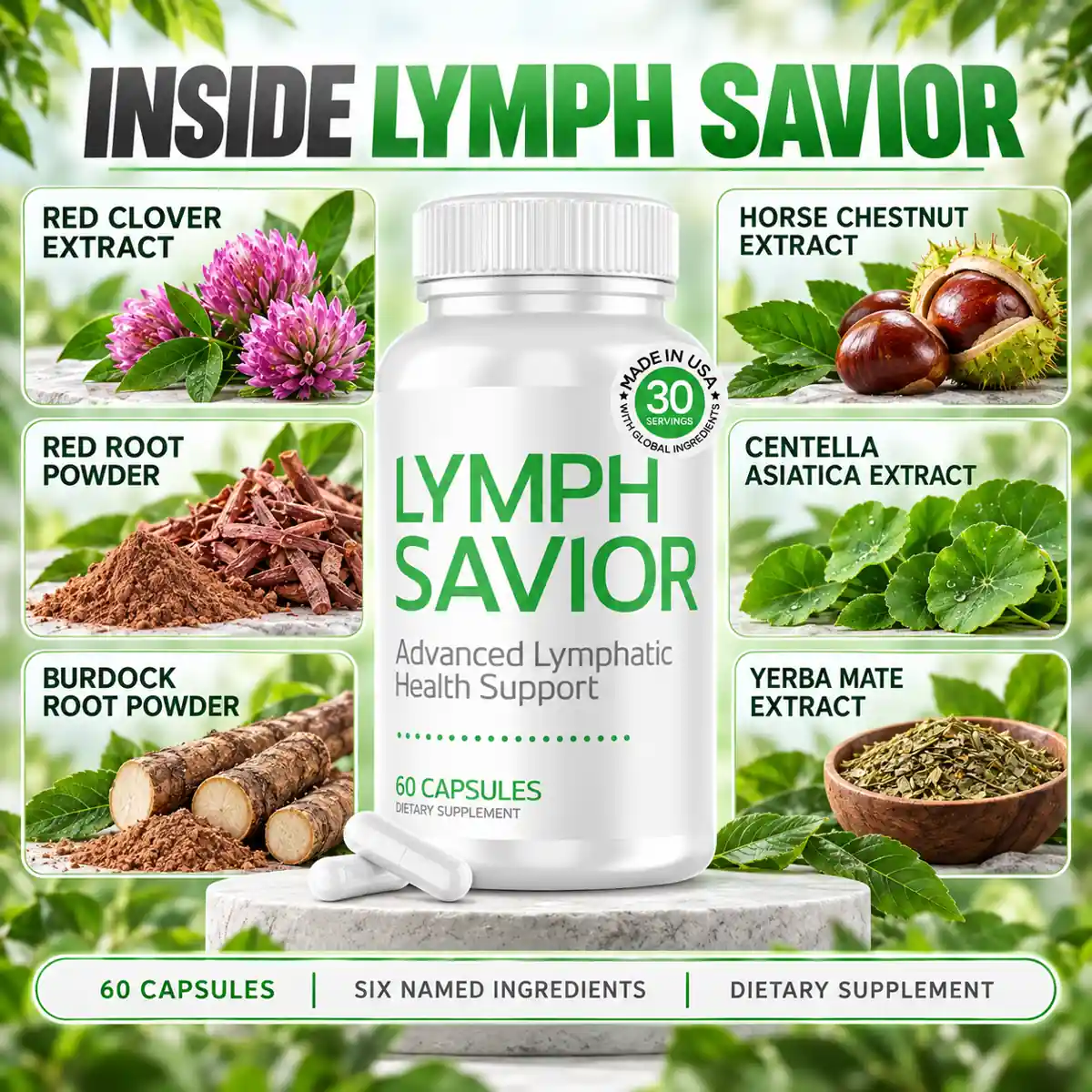
Centella asiatica, commonly called gotu kola or Indian pennywort, is a creeping marsh plant native to the wetlands of South and Southeast Asia, used for centuries in Ayurvedic and traditional Chinese formulas and, separately, studied since the mid-twentieth century by French and Italian vascular researchers for its effects on connective tissue and the smallest blood vessels. The plant has several active constituent groups, chiefly a set of triterpenoid compounds — asiaticoside, madecassoside, asiatic acid and madecassic acid — that are concentrated in the leaves and stems rather than the root.
The Lymph Savior label specifies aerial parts, meaning the above-ground portion of the plant: leaf and stem together, harvested rather than dug. That specification matters because it rules out a root extract, and because it is the same plant part the clinical literature on Centella and venous function generally uses. A label that named "root" or left the part unspecified would be harder to connect to that literature; this one does name it, and the part named lines up.
What the label does not specify is a standardization. Commercial Centella extracts used in vascular research are frequently standardized to a defined percentage of those triterpenoid compounds, under trade names such as TECA or TTFCA. This label carries no such standardization figure for Centella, unlike two other lines on the same panel: Horse Chestnut is printed "std. to 20% aescin" and Olive Leaf is printed "20% oleuropein." Centella's line carries no comparable percentage. That is a printed fact, not an inference, and it means the 125 mcg cannot be read as 125 mcg of any specific standardized marker compound — only as 125 mcg of an extract whose internal composition the label does not disclose.
What a systematic review of eight trials actually found
The most directly relevant published research is a systematic review by Chong and Aziz, "A Systematic Review of the Efficacy of Centella asiatica for Improvement of the Signs and Symptoms of Chronic Venous Insufficiency," published in Evidence-Based Complementary and Alternative Medicine in 2013 (PMID 23533507). The review identified and pooled eight randomized controlled trials testing Centella asiatica against placebo or against another phlebotonic agent in people with chronic venous insufficiency — the medical term for veins that no longer return blood from the legs efficiently, producing heaviness, swelling and visible changes in the skin and surface vessels.
Across those eight trials, the review's own language is that Centella asiatica "significantly improved microcirculatory parameters such as transcutaneous partial pressure of CO2 and O2, rate of ankle swelling and venoarteriolar response." In plain terms: several of the trials measured how efficiently oxygen and carbon dioxide exchange across the capillary wall in the lower leg, how quickly ankle circumference increased over a fixed period of standing or sitting, and how the small vessels responded reflexively to a change in limb position — three established laboratory measures of microcirculatory function used in vascular research, distinct from simply asking a participant whether their legs felt better. Several of the eight trials also reported improvement in subjective symptoms: heaviness, pain and visible edema.
What "significantly improved" means in a review like this one
It is worth being precise about what that sentence is and is not claiming. It means that, pooled or individually, a meaningful number of the eight trials reported statistically significant differences between the Centella group and the comparison group on those specific measures. It does not mean every trial reported every outcome, it does not mean the effect size was large in a clinical sense, and it does not mean the finding would replicate in a differently designed trial using a different extract at a different dose. A systematic review summarizes what was published; it does not re-run the experiments.
The review's own caution, and why it outweighs the headline
The same review immediately qualifies its own finding, and the qualification is the more important half of the paper for anyone deciding what to make of a 125 mcg line on a capsule bottle. In the authors' own words, "most of the studies were characterised by inadequate reporting and thus had unclear risks of bias." Three of the eight trials, by the review's own account, provided no usable quantitative data at all — meaning they could describe an outcome in words without supplying the numbers a reader could independently check.
"Unclear risk of bias" is a specific category in systematic-review methodology, distinct from "high risk of bias." It means the review's authors could not determine, from what the original trial reports disclosed, whether randomization was done properly, whether participants and assessors were blinded, or whether all planned outcomes were reported. It is an honest "we cannot tell," not a finding that the trials were flawed, and not a finding that they were sound. A reader who takes only the positive sentence from this abstract and skips the limitation is reading half a paper.
It establishes that Centella asiatica has been formally studied, more than once, specifically in chronic venous insufficiency, with several trials reporting favorable microcirculatory and symptomatic results. It does not establish a dose-response relationship, a standardized extract, or a bias-free evidence base strong enough to predict what a 125 mcg capsule ingredient will do for a given person.
Centella inside a larger number: the phlebotonics class review
A second, larger and more recent Cochrane review puts Centella's result in a wider context. "Phlebotonics for Venous Insufficiency," by Martinez-Zapata and colleagues, published in the Cochrane Database of Systematic Reviews in November 2020 (PMID 33141449), pools 69 randomized trials of the entire phlebotonic drug class — a category of plant-derived and semisynthetic compounds used for venous insufficiency that includes Centella alongside horse chestnut extract, diosmin, rutosides, and several others. Of those 69 trials, the review identifies two specifically testing Centella asiatica, a small fraction of the total evidence base the review draws on.
For the class as a whole, the Cochrane review reports moderate-certainty evidence that phlebotonics reduce lower-leg swelling: a relative risk of 0.70 (95% CI 0.63 to 0.78) drawn from 13 studies covering 1,245 participants, alongside a mean reduction in ankle circumference of roughly 4.27 mm. On the safety side, the same review reports that phlebotonics "probably increase adverse events slightly, compared to placebo," a relative risk of 1.14 (95% CI 1.02 to 1.27) from 37 studies, with gastrointestinal disturbance the most commonly reported event.
Those figures describe the phlebotonic drug class as a whole, pooling Centella with several other compounds; they are not a Centella-specific effect size, and this page does not present them as one. They are included because they are the best available moderate-certainty estimate of what this category of ingredient does on average, and because they carry the honest caveat — a small increase in adverse events — that a single positive-sounding systematic review can leave out.
What 125 micrograms does and does not tell a reader
Here is the specific, narrow question this page can actually answer: does 125 mcg correspond to the amount used in any of the ten published Centella trials referenced above? The honest answer is that it cannot be checked, because neither the Chong and Aziz review nor the Cochrane phlebotonics review reports a single pooled or representative milligram dose for the Centella trials they summarize — the underlying studies used varying extracts, varying standardizations, and, in several cases, did not report dose with enough detail for a reviewer to extract a clean figure. A dose comparison that cannot be run honestly should not be run with an invented number standing in for the missing one.
What can be said with confidence is narrower but still useful. 125 micrograms is a very small quantity for a botanical extract; herbal supplement doses, standardized or not, are conventionally measured and labeled in milligrams, not micrograms, and a milligram is one thousand times larger than a microgram. Whether the "mcg" printed on this panel is the amount the manufacturer intends, or whether it reflects a labeling error where "mg" was intended, is not something this page can determine from the printed label alone, and it is not a question this page will guess the answer to. The panel is reproduced here exactly as printed, unit included, because silently "correcting" a label to what seems more plausible would replace one unverified number with another.
| Printed line | Amount | Standardization printed |
|---|---|---|
| Red Clover Extract (leaves and flowers) | 225 mcg | None printed |
| Horse Chestnut Extract (seed) | 200 mcg | std. to 20% aescin |
| Red Root Powder | 210 mcg | None printed |
| Centella asiatica Extract (aerial parts) | 125 mcg | None printed |
| Burdock Powder (root) | 100 mcg | None printed |
| Yerba Mate Extract (leaves) | 100 mcg | None printed |
| Stillingia Extract (root) | 100 mcg | None printed |
| Olive Leaf Extract | 75 mcg | 20% oleuropein |
| Cleavers Extract (whole herb) | 75 mcg | None printed |
| Ginger Powder (root) | 50 mcg | None printed |
| Echinacea purpurea Powder | 25 mcg | None printed |
Reproduced exactly as printed on the Lymph Savior Supplement Facts panel, serving size two capsules, servings per container 30. Order is the order printed; the panel places Red Root (210 mcg) below Horse Chestnut (200 mcg) despite the higher number, which this page reproduces rather than "correcting."
Read the full Supplement Facts panel before deciding
Eleven printed lines, every amount in micrograms, two standardizations noted and nine left blank. The panel is reproduced in full further down this website for anyone who wants every figure in one place.
Four pack sizes, priced at the seller’s checkout, with 180 days from purchase on every one
Choose A Lymph Savior PackSwallowed whole, two a day with 6–8 oz of water, 60 to a bottle.
How to read this line next to the rest of the panel
Three things follow from setting the Centella line beside its evidence, rather than beside the rest of the marketing copy around it.
- The ingredient has a real, specific clinical literature. Unlike some names on this same panel, Centella asiatica for venous and microcirculatory outcomes has been tested in named, indexed, randomized trials — not just used traditionally.
- The literature comes with its own warning label. The review that found the positive result is the same review that called most of its own included trials unclear for risk of bias. Both halves of that sentence belong in any summary of it.
- The amount cannot be checked against the trials. 125 mcg is what the panel prints. No published review of Centella in venous insufficiency gives a comparable milligram figure to check it against, so no comparison is offered here.
None of that is a reason to dismiss the ingredient, and none of it is a reason to expect a specific result from it either. It is what the printed amount and the published research, read side by side rather than separately, actually support.
- Chong NJ, Aziz Z. A Systematic Review of the Efficacy of Centella asiatica for Improvement of the Signs and Symptoms of Chronic Venous Insufficiency. Evid Based Complement Alternat Med. 2013;2013:627182. Eight randomized trials; pooled results favoured Centella on microcirculatory measures including ankle swelling rate, transcutaneous CO2/O2 pressure and venoarteriolar response, with the authors warning that inadequate reporting leaves the risk of bias unclear in most of the eight. PMID 23533507. https://pubmed.ncbi.nlm.nih.gov/23533507/
- Martinez-Zapata MJ, Vernooij RW, Simancas-Racines D, et al. Phlebotonics for venous insufficiency. Cochrane Database Syst Rev. 2020;11(11):CD003229. Sixty-nine randomized trials of the phlebotonic drug class, including two on Centella asiatica; moderate-certainty evidence of reduced oedema (RR 0.70, 95% CI 0.63–0.78, 13 studies, 1,245 participants) and a small increase in adverse events versus placebo (RR 1.14, 95% CI 1.02–1.27, 37 studies). PMID 33141449. https://pubmed.ncbi.nlm.nih.gov/33141449/
- U.S. Food and Drug Administration. 21 CFR 101.36 – Nutrition labeling of dietary supplements. Governs the "Daily Value not established" footnote used for botanical ingredients with no federal reference intake. https://www.ecfr.gov/current/title-21/chapter-I/subchapter-B/part-101/subpart-A/section-101.36