Lymph Savior Official Website › Ingredients
IngredientsLymph Savior Ingredients: the six botanicals, and what each has been tested at
Six botanicals are named on the bottle artwork and on the brand’s own ingredient graphic: red clover, horse chestnut seed, red root, Centella asiatica, burdock root and yerba mate. No amount is printed beside any of them, because the artwork carries no Supplement Facts panel. Five of the six have been given to people in a published study. One has not.
What each plant is, what part of it the label specifies, what the published research used, and where the evidence runs out.
What is in Lymph Savior, exactly as the label sets it out
Six names, two sources, and no disagreement between them.
| Printed name | Botanical | What it is |
|---|---|---|
| Red Clover Extract (leaves and flowers) | Trifolium pratense | a pasture legume whose isoflavones behave weakly like oestrogen |
| Horse Chestnut Extract (Aesculus hippocastanum) (seed) | Aesculus hippocastanum | the seed, standardised elsewhere to its saponin aescin |
| Red Root Powder | Ceanothus americanus | New Jersey tea, a North American shrub with a long folk record and no trials |
| Centella asiatica Extract (aerial parts) | Centella asiatica | gotu kola, the leaf and stem, used in venous-tone research |
| Burdock Powder (root) | Arctium lappa | the root, eaten as a vegetable in Japan and drunk as a tea |
| Yerba Mate Extract (Ilex paraguayensis) (leaves) | Ilex paraguariensis | the leaf of the South American holly, and the only caffeine on this label |
Reproduced in the order the artwork prints them, parenthetical plant parts included. The plant part matters more than it looks: horse chestnut is specified as the seed, and that is the part the clinical literature is about.
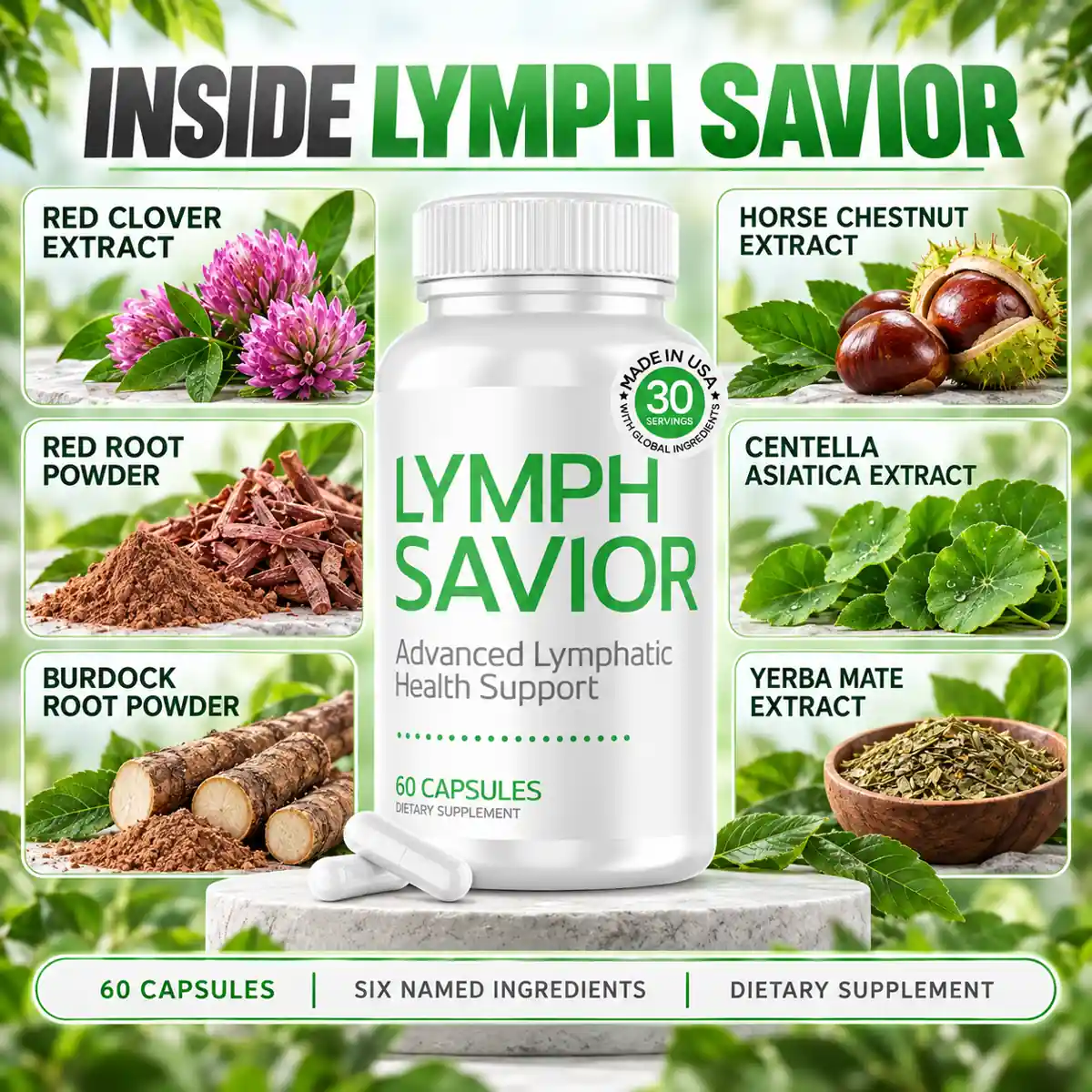
The brand publishes its own ingredient graphic and it names the same six, in the same order, with a photograph of each plant and a footer repeating 60 capsules, six named ingredients, dietary supplement.
That agreement is worth noting because it is not the usual case. On many labels the advertising names fewer ingredients than the bottle, and the gap between the two lists is the most interesting thing about the product. Here the two lists match exactly.
What neither carries is a quantity, and that is the fact this page returns to further down.
Each Lymph Savior botanical, and the research behind the plant
Six cards. The right-hand tag on each one is what the label says about quantity, which is the same thing in every case.
Red Clover Extract
Trifolium pratense, leaves and flowersNo amount printedA pasture legume, and one of the most-studied botanicals on this label. Its isoflavones, chiefly biochanin A and formononetin, are weakly oestrogen-like; a 2021 pharmacological overview sets out that chemistry in detail.
The clinical record is real and it is about menopausal symptoms rather than swelling. A meta-analysis of eight trials found a reduction in daily hot flushes, and the effect appeared where the isoflavone dose was 80 mg a day or more and the follow-up ran twelve weeks. NCCIH records clinical use for as long as two years with apparent safety, and advises against it in pregnancy or while breastfeeding.
Traditional Western herbalism has used red clover as a lymphatic and “blood-cleansing” herb for a very long time. That tradition is why it heads this list; it is not why anyone should expect a result.
Horse Chestnut Extract
Aesculus hippocastanum, seedNo amount printedThe strongest evidence on the label, by a distance. The Cochrane review pools seventeen randomised trials of horse chestnut seed extract in chronic venous insufficiency: leg pain improved in six of seven placebo-controlled trials, and six trials covering 502 people gave a weighted mean leg-volume reduction of 32.1 mL.
The single most striking trial is a 240-person study published in The Lancet in 1996. Fifty milligrams of aescin twice a day, from a standardised dried seed extract, for twelve weeks, against class II compression stockings. Lower-leg volume fell 43.8 mL on the extract and 46.7 mL on the stockings, and both beat placebo.
That number carries two conditions with it and both belong here. One is anatomical: the trials were run in chronic venous insufficiency, a failure of veins rather than of lymph vessels, so lifting the figure across body systems would be lifting it out of the place it was earned. The other is preparation. NCCIH puts it bluntly: eaten raw, the seeds, bark, flowers and leaves of this tree are unsafe, because a toxic constituent sits in them; the safety record belongs to a standardised extract from which that constituent has been taken out. This label specifies the seed and specifies nothing about standardisation.
Red Root Powder
Ceanothus americanus, rootNo human clinical trial foundAlso called New Jersey tea, after its use as a leaf infusion during the American colonial boycotts. In Western folk herbalism the root is the lymphatic herb, prescribed for swollen nodes and sluggish drainage, and it is almost certainly why this formula is shaped the way it is.
A PubMed search for the botanical name on 20 September 2026 returned prairie ecology, a Frankia symbiont genome, a paper on copper-dependent plant peptide cyclases, a butterfly-nectar study and one homeopathy paper in thalassaemia. There is no clinical trial of Ceanothus americanus root in human beings, at any dose, for any indication.
That is not a reason to call the ingredient worthless; a great many traditional remedies have never been through a trial and some of them work. It is a reason not to let it carry any weight in a decision, and a reason nothing on this website rests on it.
Centella asiatica Extract
Centella asiatica, aerial partsNo amount printedGotu kola, an Asian marsh plant used in Ayurvedic and Chinese medicine and studied in the West for the small vessels. A systematic review of eight randomised trials in chronic venous insufficiency found improvement in microcirculatory measures including the rate of ankle swelling, the transcutaneous gas pressures and the venoarteriolar response.
The review is careful with itself, and this page will be too: three of the eight trials gave no usable quantitative data, and the reporting across the set was poor enough that the risk of bias stayed unclear. The Cochrane review of phlebotonics as a class, which includes Centella among the drugs assessed, rates the effect on oedema as slight, on moderate-certainty evidence, with more adverse events than placebo.
No representative dose appears on this page, because the review settles on none and inventing a figure to fill the column would be the same defect as inventing a label amount.
Burdock Powder
Arctium lappa, rootNo amount printedA vegetable before it is a supplement. Burdock root is eaten as gobo in Japan and drunk as a tea across Europe, and it is another of the traditional Western “alterative” herbs that this formula draws on.
The human evidence is thin and specific: one randomised trial in 36 people with knee osteoarthritis, over 42 days, in which the intervention group drank three cups a day of tea brewed from 2 g of root each. That is 6 g of root daily. Interleukin-6, high-sensitivity CRP and malondialdehyde all fell, and total antioxidant capacity rose.
One trial, thirty-six people, a different condition, and an amount of root no capsule can hold. It is worth reading and it is not worth building an expectation on.
Yerba Mate Extract
Ilex paraguariensis, leavesNo amount printedThe leaf of a South American holly, brewed as a social drink across Argentina, Uruguay, Paraguay and southern Brazil. It is the only caffeine-bearing plant on this label, which matters twice: for anyone sensitive to caffeine, and for anyone trying to work out a daily total, which cannot be done without a figure for the extract.
A 2025 systematic review and meta-analysis pools its effects on glycaemic control and metabolic markers, and a randomised crossover trial in non-habitual drinkers reports cardiometabolic effects in healthy and at-risk people.
The finding this desk thinks a buyer most needs is different. In a randomised crossover study in fourteen patients, a meal containing 11.4 mg of iron was taken with either water or 200 mL of mate infusion. Post-meal serum iron was dramatically lower on the mate arm. If you are treating low iron, space this capsule away from an iron tablet and say so to whoever is treating you.
What the Lymph Savior label can and cannot be compared with
The quantity gap. There is no Supplement Facts panel on the bottle, on the brand’s ingredient graphic or on the seller’s page. Six names, no figures. The practical effect is that the left-hand column above and the right-hand column cannot be joined: nobody outside the manufacturer can say whether this capsule holds a trial dose, a tenth of one, or a hundredth.
The evidence gap. Five of the six have been given to human beings in a published study. Red root has not. Both facts are on this page because both are checkable, and a buyer who knows them is in a better position than one who does not.
Neither is a reason to say the product does not work. They are the reason this website does not say it does, and the reason the 180-day window is the part of the offer that carries the most weight.
The seller’s landing page leads with a two-second “edema flush” said to reduce swelling by 548 per cent. Nothing in the right-hand column above resembles that. The largest horse chestnut trial moved lower-leg volume by 43.8 mL over twelve weeks. That is the honest scale of the published effect for the best-evidenced plant on this label.
Who publishes this Lymph Savior website, and what it read
Thirteen sources, read through the NCBI interface or fetched directly on the day this page was written.
- Pittler MH, Ernst E. Horse chestnut seed extract for chronic venous insufficiency. Cochrane Database Syst Rev. 2012;11(11):CD003230. Seventeen randomised trials: leg pain improved in six of seven placebo-controlled trials, and six trials (n=502) gave a weighted mean leg-volume reduction of 32.1 mL. The review calls the trials suggestive rather than definitive. PMID 23152216. https://pubmed.ncbi.nlm.nih.gov/23152216/
- Diehm C, Trampisch HJ, Lange S, et al. Comparison of leg compression stocking and oral horse-chestnut seed extract therapy in patients with chronic venous insufficiency. Lancet. 1996;347(8997):292-4. 50 mg aescin twice daily -- 100 mg a day -- for 12 weeks in 240 people. Lower-leg volume fell 43.8 mL on the extract and 46.7 mL on class II compression stockings. PMID 8569363. https://pubmed.ncbi.nlm.nih.gov/8569363/
- National Center for Complementary and Integrative Health. Horse Chestnut. States that raw seeds, bark, flowers and leaves are unsafe taken by mouth because they contain a toxic component, that STANDARDISED seed extracts with that component removed are likely safe for short-term use, and that the research record covers up to 12 weeks. https://www.nccih.nih.gov/health/horse-chestnut
- Marciano G, Vocca C, Diracoglu D, et al. Escin's Action on Bradykinin Pathway: Advantageous Clinical Properties for an Unknown Mechanism? Antioxidants (Basel). 2024;13(9):1130. A review of the proposed mechanism, which is still described in the literature as incompletely understood. PMID 39334789. https://pubmed.ncbi.nlm.nih.gov/39334789/
- Chong NJ, Aziz Z. A Systematic Review of the Efficacy of Centella asiatica for Improvement of the Signs and Symptoms of Chronic Venous Insufficiency. Evid Based Complement Alternat Med. 2013;2013:627182. Eight trials; pooled results favoured Centella on microcirculatory measures including ankle swelling rate, with the authors warning that inadequate reporting leaves the risk of bias unclear. PMID 23533507. https://pubmed.ncbi.nlm.nih.gov/23533507/
- Martinez-Zapata MJ, Vernooij RW, Simancas-Racines D, et al. Phlebotonics for venous insufficiency. Cochrane Database Syst Rev. 2020;11(11):CD003229. Sixty-nine randomised trials of oral phlebotonics, Centella asiatica among the drugs assessed; moderate-certainty evidence that they reduce oedema slightly, with more adverse events than placebo. PMID 33141449. https://pubmed.ncbi.nlm.nih.gov/33141449/
- Kanadys W, Baranska A, Blaszczuk A, et al. Evaluation of Clinical Meaningfulness of Red Clover (Trifolium pratense L.) Extract to Relieve Hot Flushes and Menopausal Symptoms in Peri- and Post-Menopausal Women: A Systematic Review and Meta-Analysis of Randomized Controlled Trials. Nutrients. 2021;13(4):1258. Eight trials, ten comparisons; the effect appeared at an isoflavone dose of 80 mg a day or more over 12 weeks. PMID 33920485. https://pubmed.ncbi.nlm.nih.gov/33920485/
- Mohsen A, Fatemeh K, Leila N, et al. Pharmacological and therapeutic properties of the Red Clover (Trifolium pratense L.): an overview of the new finding. J Tradit Chin Med. 2021;41(4):642-649. Reviews the isoflavone chemistry -- biochanin A, formononetin, genistein, daidzein -- that gives the plant its oestrogen-like activity. PMID 34392659. https://pubmed.ncbi.nlm.nih.gov/34392659/
- National Center for Complementary and Integrative Health. Red Clover. Records clinical use for as long as two years with apparent safety and good tolerability, and states that red clover supplements may be unsafe in pregnancy or while breastfeeding. https://www.nccih.nih.gov/health/red-clover
- Maghsoumi-Norouzabad L, Alipoor B, Abed R, et al. Effects of Arctium lappa L. (Burdock) root tea on inflammatory status and oxidative stress in patients with knee osteoarthritis. Int J Rheum Dis. 2016;19(3):255-61. Thirty-six people, 42 days, three cups a day of tea made from 2 g of root each -- 6 g a day. IL-6, hs-CRP and malondialdehyde fell. PMID 25350500. https://pubmed.ncbi.nlm.nih.gov/25350500/
- Li D, Yue L, Peng X, et al. Yerba Mate and its impact on glycemic control and metabolic health: a systematic review and meta-analysis. Front Endocrinol (Lausanne). 2025;16:1641592. Pools the human trials of mate on glycaemic and metabolic outcomes. PMID 41244043. https://pubmed.ncbi.nlm.nih.gov/41244043/
- Bravo L, Martinez-Lopez S, Sierra-Cinos JL, et al. Yerba Mate (Ilex paraguariensis St. Hill.) Tea May Have Cardiometabolic Beneficial Effects in Healthy and At-Risk Subjects: A Randomized, Controlled, Blind, Crossover Trial in Nonhabitual Consumers. Mol Nutr Food Res. 2025;69(15):e70065. PMID 40263915. https://pubmed.ncbi.nlm.nih.gov/40263915/
- Pagliosa CM, Vieira FGK, Dias BV, et al. Ilex paraguariensis (A. St.-Hil.) leaf infusion decreases iron absorption in patients with hereditary hemochromatosis: a randomized controlled crossover study. Food Funct. 2021;12(16):7321-7328. Fourteen patients, a meal containing 11.4 mg of iron taken with 200 mL of mate infusion or with water; post-meal serum iron fell sharply on the mate arm. PMID 34173816. https://pubmed.ncbi.nlm.nih.gov/34173816/
Read further on this Lymph Savior website
Read the Lymph Savior label, then decide with the window in mind
Six botanicals, two capsules a day, sixty to a bottle. What the artwork prints is what these pages print.
Four pack sizes, priced at the seller’s checkout, with 180 days from purchase on every one
Choose A Lymph Savior PackSwallowed whole, two a day with 6–8 oz of water, 60 to a bottle. Batch LYM-26/LY-5549, shipped from the United States.