Lymph Savior Official Website › How It Works
How It WorksHow Does Lymph Savior Work? The four mechanisms behind the six botanicals
There is no single mechanism, and any page that offers one is simplifying. What the published literature describes for these six plants is four separate things: vessel wall tone, microcirculation, isoflavone activity, and the daily routine the capsule is taken inside. The first three are studied in veins and in menopause rather than in lymph.
What each mechanism is, which plant carries it, and the honest distance between a trial of a plant and a capsule containing it.
What the lymphatic system does, before Lymph Savior is involved at all
The lymphatic system is a one-way drainage network. Blood capillaries leak fluid into tissue by design; lymphatic capillaries collect it, carry it through a chain of nodes where immune cells sample it, and return it to the bloodstream near the collarbone.
It has no heart. It moves for three reasons: skeletal muscle squeezing the vessels as you walk, the pressure swing in the chest as you breathe, and slow contractions in the vessel walls themselves. A 2026 review in Ageing Research Reviews sets out how that machinery changes with age.
Three consequences follow, and they frame everything else on this page. Movement is the pump. Standing still for hours is the opposite of a pump. And an oral capsule has no direct route to a lymph vessel wall that anyone has measured.
The four mechanisms Lymph Savior draws on
Vessel wall tone, from horse chestnut seed
Aescin, the saponin fraction of horse chestnut seed, is studied for its effect on capillary permeability and venous tone. A 2024 review works through the bradykinin pathway proposed for it and still calls the mechanism incompletely understood. The clinical effect is better established than the explanation for it: the Lancet trial put 100 mg of aescin a day against compression stockings for twelve weeks and found them equivalent on leg volume.
Microcirculation, from Centella asiatica
Centella is studied for the smallest vessels and the connective tissue around them. The pooled trials report improvement in the rate of ankle swelling and in transcutaneous gas pressures, which are measures of how well fluid and oxygen are moving at the skin. The same review is candid that the trials were poorly reported.
Isoflavone activity, from red clover
Biochanin A and formononetin bind weakly at oestrogen receptors. That is the basis of red clover’s clinical literature, and that literature is about hot flushes, at 80 mg of isoflavones a day over twelve weeks. It is not about fluid. It is included here because the ingredient is on the label and a reader is entitled to know what it is actually known for.
The routine, which is the part nobody sells
Two capsules and a full glass of water, at the same time every day. Lymph moves because the body moves and because the body is hydrated, so the habit is not a footnote to the mechanism. Walking is the one part of that routine whose mechanism nobody disputes, so a capsule taken after the morning walk is tested in the fairest conditions it will get.
Every mechanism above is a mechanism of a plant, measured at a stated dose, in a named condition. This capsule states no dose, and its blend has never been trialled as a blend. So what the mechanisms establish is that the ingredients are plausible choices, not that the finished product reproduces any published result.
What Lymph Savior is not doing, however it is described elsewhere
It is not flushing anything
No published human trial has measured a capsule changing lymph flow. No consumer test reports a toxin load to be cleared. The word does not appear on this website as a claim and it does not appear on the bottle.
It is not a diuretic
Nothing on this label is a diuretic and the artwork claims nothing of the kind. A product that shifted water weight would be doing something different, and would need to say so.
It is not a treatment for lymphoedema
Lymphoedema is a diagnosis. The Cochrane comparison is between microsurgery and complex physical decongestive therapy, and no oral supplement appears in either arm. The National Cancer Institute page lists compression, skin care, exercise and manual drainage.
It is not fast
The two best-evidenced plants on the label were trialled over twelve weeks. Reviewers here describe three to four. Nothing in either record supports a change measured in seconds or days.
Why the best evidence for Lymph Savior botanicals comes from vein research
Two of the six plants on this label have a serious clinical literature, and in both cases that literature is in chronic venous insufficiency. That is worth explaining rather than glossing, because it is the single most important piece of context for reading any claim in this category.
Veins carry blood back to the heart against gravity, helped by one-way valves and by the calf muscle squeezing them. When those valves leak, pressure rises in the small vessels at the ankle, fluid is pushed into the tissue faster than it can be collected, and the leg aches and swells by evening. Lymphatic vessels are the collection side of that same problem: they are what removes the fluid once it has arrived.
So the two systems meet at the ankle and they fail in ways that look identical from the outside. A person with heavy legs at six o’clock usually cannot tell which side of that exchange is struggling, and in many cases both are. That overlap is the honest reason a venous-insufficiency literature is relevant to a lymphatic supplement.
It is also the reason the two must not be collapsed. The Cochrane review measured leg volume in people diagnosed with a vein problem. It did not measure lymph flow, lymph node function or lymphatic vessel contraction in anybody. Describing its result as a lymphatic finding would be a real misuse of a real paper, and it is the misuse this category commits most often.
A trial of this blend, at a stated dose, measuring limb volume or lymphatic transport in people with the complaint the bottle is sold for. No such trial exists for this product, or, as far as the indexed literature goes, for any product with this combination of six. That is the position, and it is the same position almost every blend on this shelf is in.
Who publishes this Lymph Savior website, and what it read
- Rojas Velazquez MN, Gousopoulos E, Wolf S, et al. Ageing and the lymphatic system: Implications for immunity, brain health, and possible therapeutic interventions. Ageing Res Rev. 2026;118:103126. PMID 41936901. https://pubmed.ncbi.nlm.nih.gov/41936901/
- Diehm C, Trampisch HJ, Lange S, et al. Comparison of leg compression stocking and oral horse-chestnut seed extract therapy in patients with chronic venous insufficiency. Lancet. 1996;347(8997):292-4. 50 mg aescin twice daily -- 100 mg a day -- for 12 weeks in 240 people. Lower-leg volume fell 43.8 mL on the extract and 46.7 mL on class II compression stockings. PMID 8569363. https://pubmed.ncbi.nlm.nih.gov/8569363/
- Pittler MH, Ernst E. Horse chestnut seed extract for chronic venous insufficiency. Cochrane Database Syst Rev. 2012;11(11):CD003230. Seventeen randomised trials: leg pain improved in six of seven placebo-controlled trials, and six trials (n=502) gave a weighted mean leg-volume reduction of 32.1 mL. The review calls the trials suggestive rather than definitive. PMID 23152216. https://pubmed.ncbi.nlm.nih.gov/23152216/
- Marciano G, Vocca C, Diracoglu D, et al. Escin's Action on Bradykinin Pathway: Advantageous Clinical Properties for an Unknown Mechanism? Antioxidants (Basel). 2024;13(9):1130. A review of the proposed mechanism, which is still described in the literature as incompletely understood. PMID 39334789. https://pubmed.ncbi.nlm.nih.gov/39334789/
- Chong NJ, Aziz Z. A Systematic Review of the Efficacy of Centella asiatica for Improvement of the Signs and Symptoms of Chronic Venous Insufficiency. Evid Based Complement Alternat Med. 2013;2013:627182. Eight trials; pooled results favoured Centella on microcirculatory measures including ankle swelling rate, with the authors warning that inadequate reporting leaves the risk of bias unclear. PMID 23533507. https://pubmed.ncbi.nlm.nih.gov/23533507/
- Kanadys W, Baranska A, Blaszczuk A, et al. Evaluation of Clinical Meaningfulness of Red Clover (Trifolium pratense L.) Extract to Relieve Hot Flushes and Menopausal Symptoms in Peri- and Post-Menopausal Women: A Systematic Review and Meta-Analysis of Randomized Controlled Trials. Nutrients. 2021;13(4):1258. Eight trials, ten comparisons; the effect appeared at an isoflavone dose of 80 mg a day or more over 12 weeks. PMID 33920485. https://pubmed.ncbi.nlm.nih.gov/33920485/
- Haas Y, Williams OP, Masia J, et al. Microsurgical versus complex physical decongestive therapy for chronic breast cancer-related lymphoedema. Cochrane Database Syst Rev. 2025;2(2):CD016019. The comparison is between surgery and physical decongestive therapy; no oral supplement appears in either arm. PMID 39945379. https://pubmed.ncbi.nlm.nih.gov/39945379/
- National Cancer Institute. Lymphedema. Describes compression, skin care, exercise and manual lymphatic drainage as the management that is actually used, and the signs that need a clinician. https://www.cancer.gov/about-cancer/treatment/side-effects/lymphedema
Read further on this Lymph Savior website
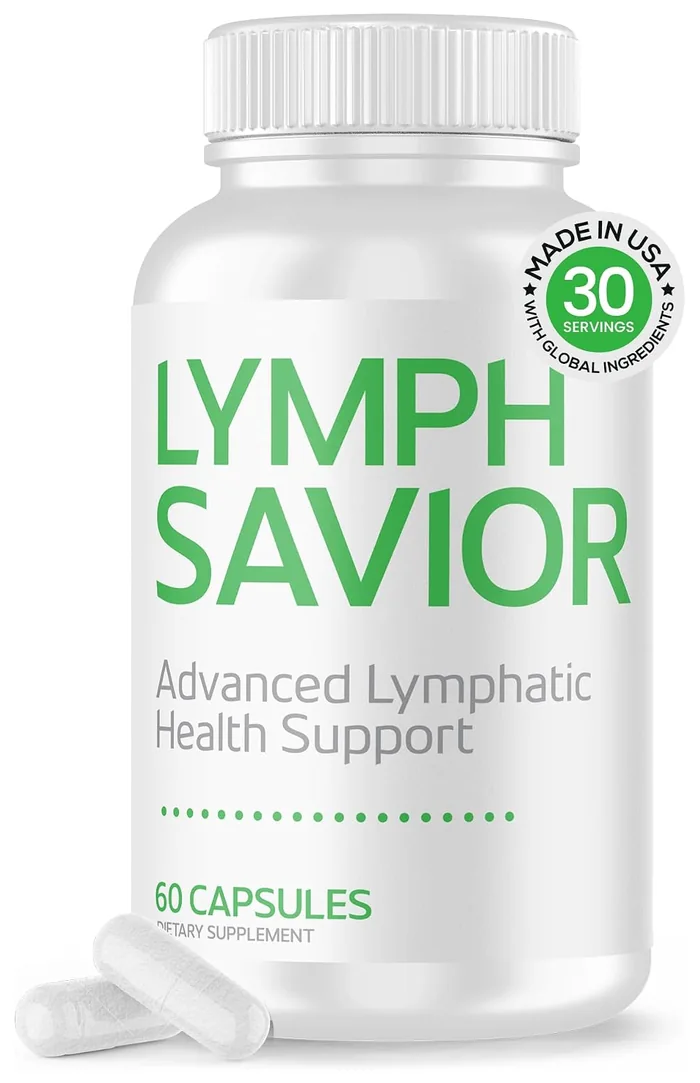
Two capsules a day is the whole of the Lymph Savior routine
Sixty capsules, thirty servings, one month. The mechanism arguments are on this page; the bottle is simpler than they are.
Four pack sizes, priced at the seller’s checkout, with 180 days from purchase on every one
Choose A Lymph Savior PackSwallowed whole, two a day with 6–8 oz of water, 60 to a bottle. Batch LYM-26/LY-5549, shipped from the United States.