Lymph Savior Official Website › Six names and no numbers: reading a label th
Lymph Savior journalLymph Savior Ingredients: Six Names and No Numbers on the Label
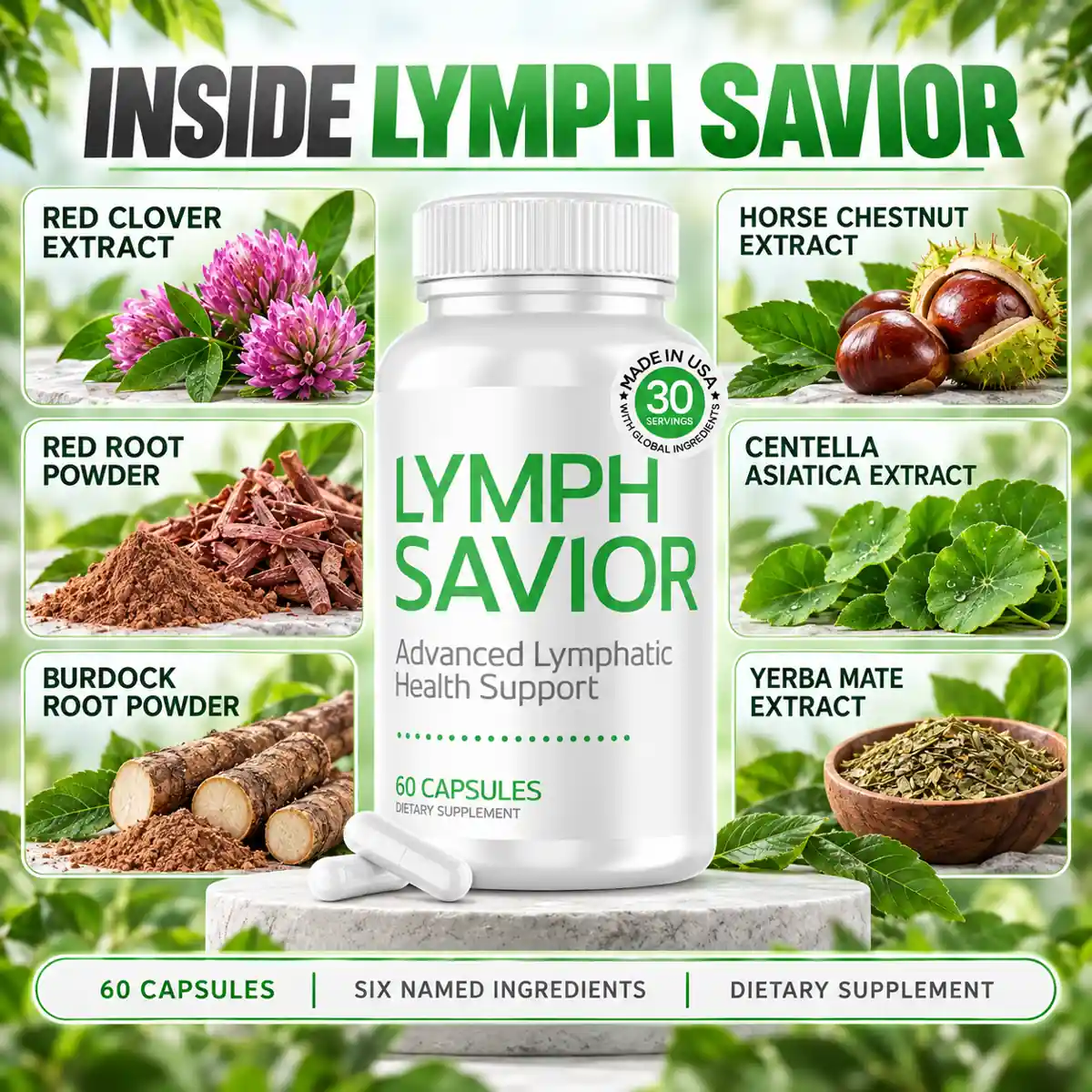
Lymph Savior ingredients are six botanicals: red clover, horse chestnut seed, red root, Centella asiatica, burdock root and yerba mate. The label prints no amount for any of them, because there is no Supplement Facts panel on the bottle, on the brand’s ingredient graphic or on the seller’s page. That decides what can honestly be said about the product, and this article sets out what it still tells you.
What a Supplement Facts panel is for
A Supplement Facts panel is the one part of a supplement label that carries arithmetic. It lists each ingredient and the amount per serving, so a buyer can set the product beside a published trial and ask whether they are in the same range. Without it a label is a list of nouns.
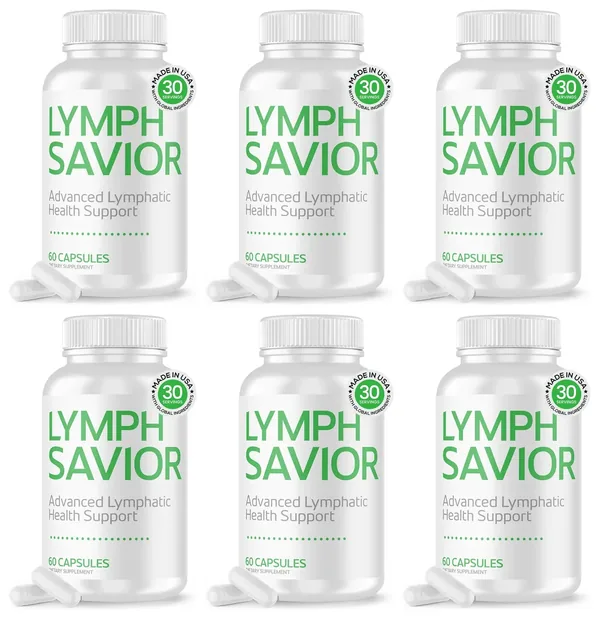
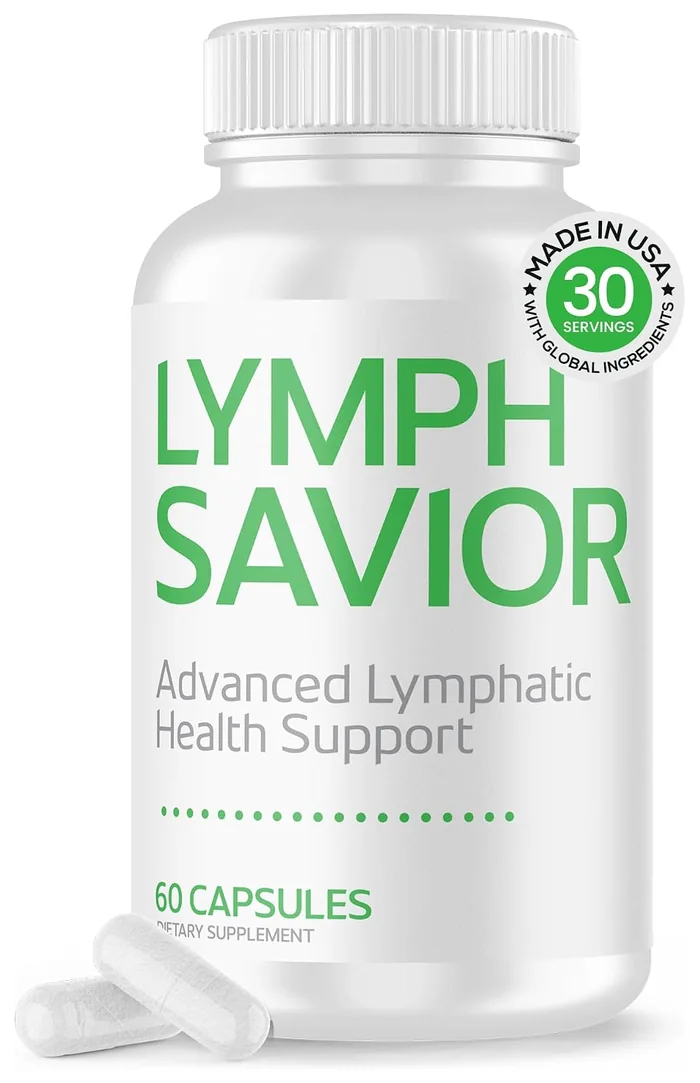
The Lymph Savior artwork carries no panel. The front names the product, the support line, the count of sixty capsules and a roundel reading made in USA, thirty servings, with global ingredients. The brand’s own ingredient graphic names six botanicals with a photograph of each and no figure beside any. The seller’s page repeats the same six.
How unusual is that?
Less unusual than it should be. Across this category a great many bottles list names without amounts, or give a single proprietary blend total that tells you the sum and not the parts. What makes this one worth writing about is that the gap is complete: there is no total, no percentage, and no standardisation figure for the one ingredient where standardisation decides everything.
What a label like this cannot tell you
| Question a panel would answer | What can be said here |
|---|---|
| How much horse chestnut seed extract per serving? | Nothing. No figure exists. |
| What percentage of aescin? | Nothing, and this is the figure that matters most. |
| How much red clover isoflavone? | Nothing. The trials found an effect at 80 mg a day. |
| How much burdock root? | Nothing. The one human trial used 6 g a day as tea. |
| How much caffeine, from the yerba mate? | Nothing, so a daily total cannot be calculated. |
| Is the blend anywhere near a trial dose? | Unanswerable from outside the manufacturer. |
Six questions, six blanks. The right-hand column is not this desk being coy; it is the whole of what is available.
The practical consequence is a single sentence. Every dose in the research column on the ingredients page belongs to a published trial of a plant, and none of them can be attributed to this capsule. Printing a trial dose next to a product as though the two were connected is the commonest sleight of hand in supplement marketing, and it is worth learning to spot.
What a label like this still tells you
More than the previous section implies, and it is worth being fair about.
- The plant parts. Leaves and flowers for red clover, seed for horse chestnut, aerial parts for Centella, root for burdock and red root, leaves for yerba mate. Many labels omit this and it genuinely matters: the evidence attaches to a part.
- The serving and the supply. Sixty capsules, thirty servings, two a day. One bottle is one month and the arithmetic needs no assumptions.
- The claim ceiling. Advanced lymphatic health support, and move freely through each day. Short enough to check, which is not nothing.
- What is not in it. No vitamins, no minerals, no stimulant other than whatever caffeine the mate carries. A short list is easier to raise with a prescriber than a long one.
- A batch reference. The lot on the base ties a bottle to a run and to an order.
See exactly what the Lymph Savior label does and does not print
Six botanicals, six plant parts, and a column of published trial doses that belong to the plants rather than to the capsule.
Four pack sizes, priced at the seller’s checkout, with 180 days from purchase on every one
Choose A Lymph Savior PackSwallowed whole, two a day with 6–8 oz of water, 60 to a bottle. Batch LYM-26/LY-5549, shipped from the United States.
The risk a missing panel actually carries
The obvious risk is that the product is underdosed, and that is real. The less obvious one is better documented. An analysis of supplement-linked liver injury cases found that chemical analysis of the implicated products repeatedly turned up contents that did not match the label. A label with no quantities is a label with less to fail to match, which is a strange kind of protection and not a reassuring one.
The mitigation is not a better reading of the bottle; there is nothing more to read. It is a traceable channel. A lot number on the base, a desk that can match it to your order, and a refund window long enough to stop if something is wrong. Those three are what the batch page is about.
Taking it to somebody who prescribes for you
If you take any medicine, this label is a harder conversation than a panel would be, and it is worth arriving prepared. Take the bottle or a photograph of it rather than a name from memory. NCCIH’s guidance on using supplements wisely is a useful five minutes beforehand, and the three specific interactions on this particular set of botanicals are listed on the safety page.
A fair verdict on a label like this
It is not a fraud and it is not evidence of one. It is a label that has decided which questions it will answer, and the questions it declines are the ones a careful buyer most wants answered.
That makes the purchase decision a different shape than it would otherwise be. Instead of comparing amounts against trials, which is impossible here, the decision rests on things that can be checked: the plant parts are right, the serving is clear, the batch is traceable, the desk answers, and the window is 180 days from purchase with opened bottles included.
Somebody who needs to know what they are taking should buy a single-ingredient horse chestnut capsule that prints its aescin figure, and this website says so on its own checklist page. Somebody who wants a simple traditional blend as a daily habit, alongside the walking that actually moves lymph, is buying something else entirely, and for them the window matters more than the panel.
Proprietary blends, and why they are the usual halfway house
Most labels that decline to print individual amounts do print a total. A proprietary blend line gives a single milligram figure for the whole mixture and lists the ingredients underneath it in descending order of weight, which is the order regulations require.
That is weaker than a full panel and much stronger than nothing. From a blend total and an ingredient order a reader can at least bound the problem: if six botanicals share 500 mg, none of them is at a gram-scale trial dose, and the sixth-listed is smaller than the first. Those are real constraints and they let a buyer rule things out.
This label does not offer even that. There is no blend total, so the only bound available is physical: a capsule shell holds what a capsule shell holds, and two of them a day is the serving. That is a much weaker constraint and it is the one this website works inside.
What ingredient order still tells you
One small thing survives. The six are printed in a fixed order on the bottle and on the brand’s graphic: red clover, horse chestnut, red root, Centella, burdock, yerba mate. On a label with a blend total that order would be by weight. Without one, it may be by weight or it may be editorial, and the label does not say which. It is worth noticing and it is not worth building on.
Three questions worth putting to any desk
A missing panel is not necessarily the end of the enquiry. A manufacturer knows its own formula, and a retailer can pass a question along. Three are worth asking, in this order.
- Is there a blend total? If the answer is a number, a great deal becomes calculable that was not calculable before.
- Is the horse chestnut seed extract standardised, and to what percentage of aescin? On this particular formula this is the highest-value question there is.
- Is the ingredient order by weight? A yes turns the printed order into information rather than layout.
A desk that answers all three has turned a closed label into a partly open one. A desk that answers none has told you something useful as well. Either way the question costs a phone call, and the number is on every page of this website.
Why a label is allowed to look like this
The short answer is that the rules govern what a label must not say more tightly than what it must disclose about a blend. Dietary supplements in the United States are not reviewed before sale; a manufacturer is responsible for its own safety and labelling, and enforcement happens afterwards if something goes wrong.
The claims side is the tightly written part. A supplement may make structure and function claims, describing support for the normal working of a body system, and may not claim to diagnose, treat, cure or prevent a disease. This label stays well inside that: advanced lymphatic health support, and move freely through each day.
The disclosure side is where the latitude sits, and a proprietary blend is a legitimate commercial choice rather than a loophole being exploited. A formulator who has spent money arriving at a ratio has a real interest in not publishing it for a competitor to copy.
Understanding that changes the tone of the complaint. The buyer’s objection is not that a law has been broken. It is that a product asking for money every month is asking to be taken on trust in a way that a fully labelled one is not, and that the price of that trust ought to be a longer window and a desk that answers. On this offer both of those are actually present.
- Halegoua-DeMarzio D, Navarro VJ, Davis A, et al. Investigation of the Role of Chemical Analysis in Causality Assessment of Herbal and Dietary Supplement-Induced Liver Injury. Drug Saf. 2025;48(2):143-150. Chemical analysis of the implicated products repeatedly found contents that did not match the label. PMID 39354283. https://pubmed.ncbi.nlm.nih.gov/39354283/
- National Center for Complementary and Integrative Health. Using Dietary Supplements Wisely. What a supplement label can and cannot tell a buyer, and why a herb is worth raising with whoever prescribes your medicines. https://www.nccih.nih.gov/health/using-dietary-supplements-wisely
- Pittler MH, Ernst E. Horse chestnut seed extract for chronic venous insufficiency. Cochrane Database Syst Rev. 2012;11(11):CD003230. Seventeen randomised trials: leg pain improved in six of seven placebo-controlled trials, and six trials (n=502) gave a weighted mean leg-volume reduction of 32.1 mL. The review calls the trials suggestive rather than definitive. PMID 23152216. https://pubmed.ncbi.nlm.nih.gov/23152216/
- Kanadys W, Baranska A, Blaszczuk A, et al. Evaluation of Clinical Meaningfulness of Red Clover (Trifolium pratense L.) Extract to Relieve Hot Flushes and Menopausal Symptoms in Peri- and Post-Menopausal Women: A Systematic Review and Meta-Analysis of Randomized Controlled Trials. Nutrients. 2021;13(4):1258. Eight trials, ten comparisons; the effect appeared at an isoflavone dose of 80 mg a day or more over 12 weeks. PMID 33920485. https://pubmed.ncbi.nlm.nih.gov/33920485/
- Maghsoumi-Norouzabad L, Alipoor B, Abed R, et al. Effects of Arctium lappa L. (Burdock) root tea on inflammatory status and oxidative stress in patients with knee osteoarthritis. Int J Rheum Dis. 2016;19(3):255-61. Thirty-six people, 42 days, three cups a day of tea made from 2 g of root each -- 6 g a day. IL-6, hs-CRP and malondialdehyde fell. PMID 25350500. https://pubmed.ncbi.nlm.nih.gov/25350500/