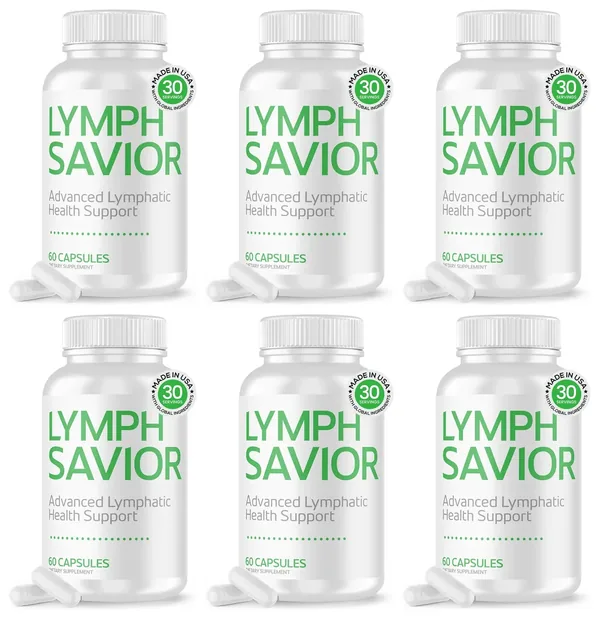
Lymph Savior Official Website › Six botanicals, five trials, and the one ing
Lymph Savior journalSix botanicals, five trials, and the one ingredient nobody has studied
Red root, Ceanothus americanus, is the fourth name on this label and the only one of the six with no human clinical literature at all. A PubMed search returns prairie ecology, a bacterial genome and a plant-enzyme paper. Tradition is why it is in the formula. It is not a result, and nothing on this website rests on it.
What red root is, and why it is on this label
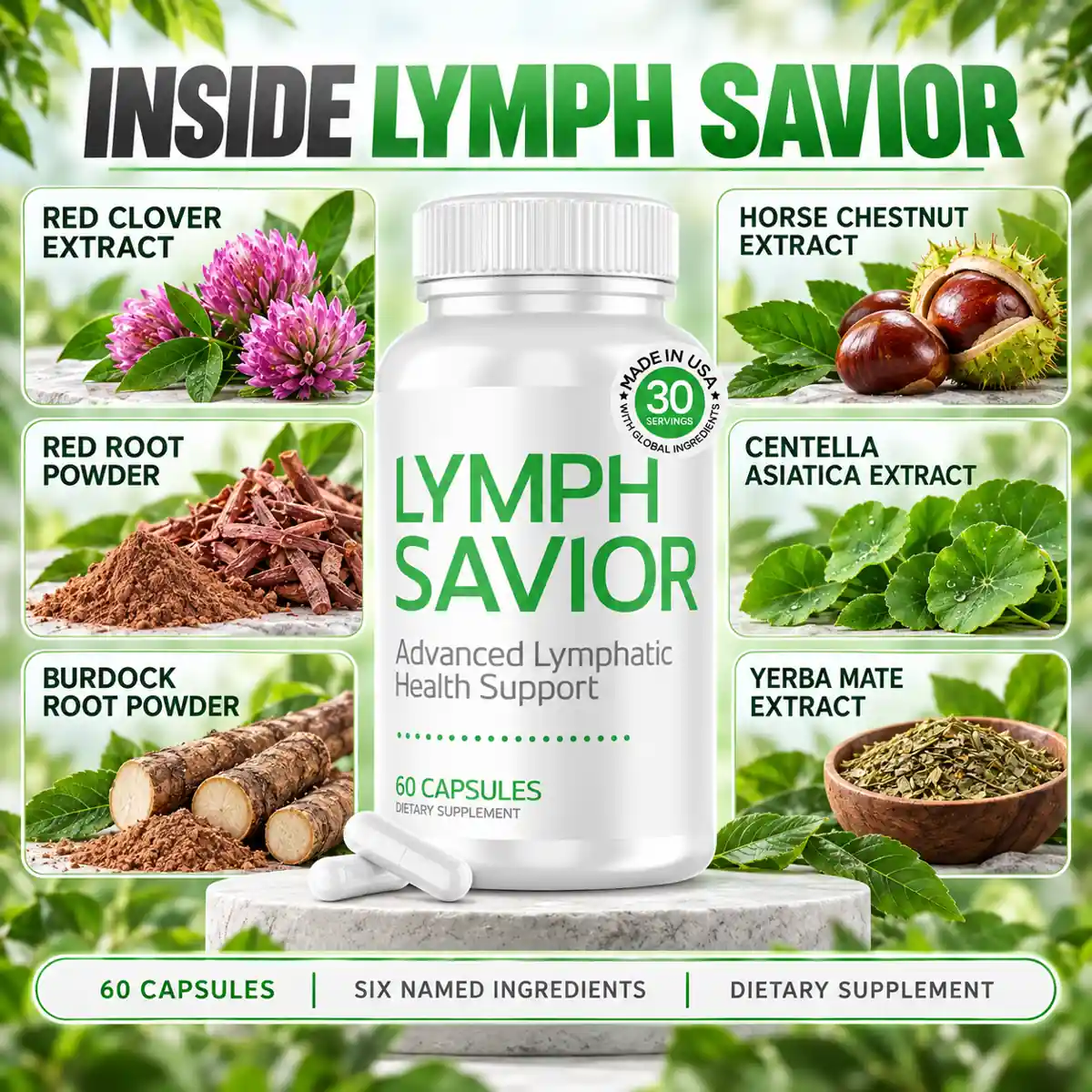
Six botanicals are named on the Lymph Savior bottle. Five of them have been given to human beings in a study somebody published and indexed. The sixth, red root, has not, and the gap between those two statements is the most interesting thing about this formula.
Red root is Ceanothus americanus, a low North American shrub also called New Jersey tea, after the leaf infusion colonists drank during the boycotts of imported tea. The root, not the leaf, is what Western herbalism uses, and it uses it for exactly one thing: the lymphatic system. In the nineteenth-century Eclectic tradition it was the lymphatic herb, prescribed for swollen nodes and what practitioners described as sluggish drainage.
That tradition is almost certainly why this formula has the shape it does. A lymphatic blend without red root would be a venous blend with a different name on the front.
What a search of the literature actually returns
On 20 September 2026 a PubMed search for the botanical name returned a scattering of papers and not one of them was a clinical trial. There was a study of butterfly nectar in oak savannas. There was a permanent draft genome of a Frankia strain, the nitrogen-fixing bacterium that lives in the plant’s root nodules. There was work on copper-dependent peptide cyclases in plants, and a paper on community structuring in Illinois tallgrass prairie. The one paper with a human being in it was a homeopathy study in thalassaemia, in which the plant appears as a named remedy among others.
That is a real absence rather than a search that was done badly. The plant is well known to botany and to microbiology. It is simply not known to clinical medicine.
What that does and does not mean
It does not mean the ingredient is inert. A great many traditional remedies have never been through a trial, and some of them will turn out to work when somebody funds the study. Absence of evidence is not evidence of absence, and a page that pretended otherwise would be overclaiming in the opposite direction.
What it does mean is narrower and more useful. Nobody can tell you what red root does in a human being, at any dose, for any outcome, because nobody has looked. So it cannot carry any weight in a purchase decision, and nothing on this website rests on it.
- No efficacy claim on this website depends on red root.
- No dose can be recommended, because none has been studied.
- No safety profile exists either, which is the part people forget: an untested plant is untested for harm as well as for benefit.
- Traditional use is a reason for a researcher to be curious. It is not a reason for a buyer to pay more.
How the other five compare
Setting red root beside its five neighbours makes the point better than any amount of argument. The column that matters is the middle one, because it names the condition each plant was studied in rather than just asserting that evidence exists.
| Botanical | Studied in | Strength of the record |
|---|---|---|
| Horse chestnut seed | Chronic venous insufficiency | A Cochrane review of seventeen randomised trials |
| Centella asiatica | Chronic venous insufficiency | A systematic review of eight trials, poorly reported |
| Red clover | Menopausal symptoms | A meta-analysis of eight trials |
| Yerba mate | Metabolic markers, and iron absorption | A 2025 meta-analysis plus a crossover trial |
| Burdock root | Knee osteoarthritis | One randomised trial in 36 people |
| Red root | Nothing | No indexed human clinical literature |
Two of the six have a serious record and both are in veins rather than in lymph. One has none.
The Cochrane review of horse chestnut seed extract pools seventeen trials and reports a weighted mean leg-volume reduction of 32.1 mL. The Centella review pools eight and warns that the reporting quality leaves the risk of bias unclear. Those are the two strong rows, and both of them are about a vein problem.
Read the whole Lymph Savior ingredient list before deciding
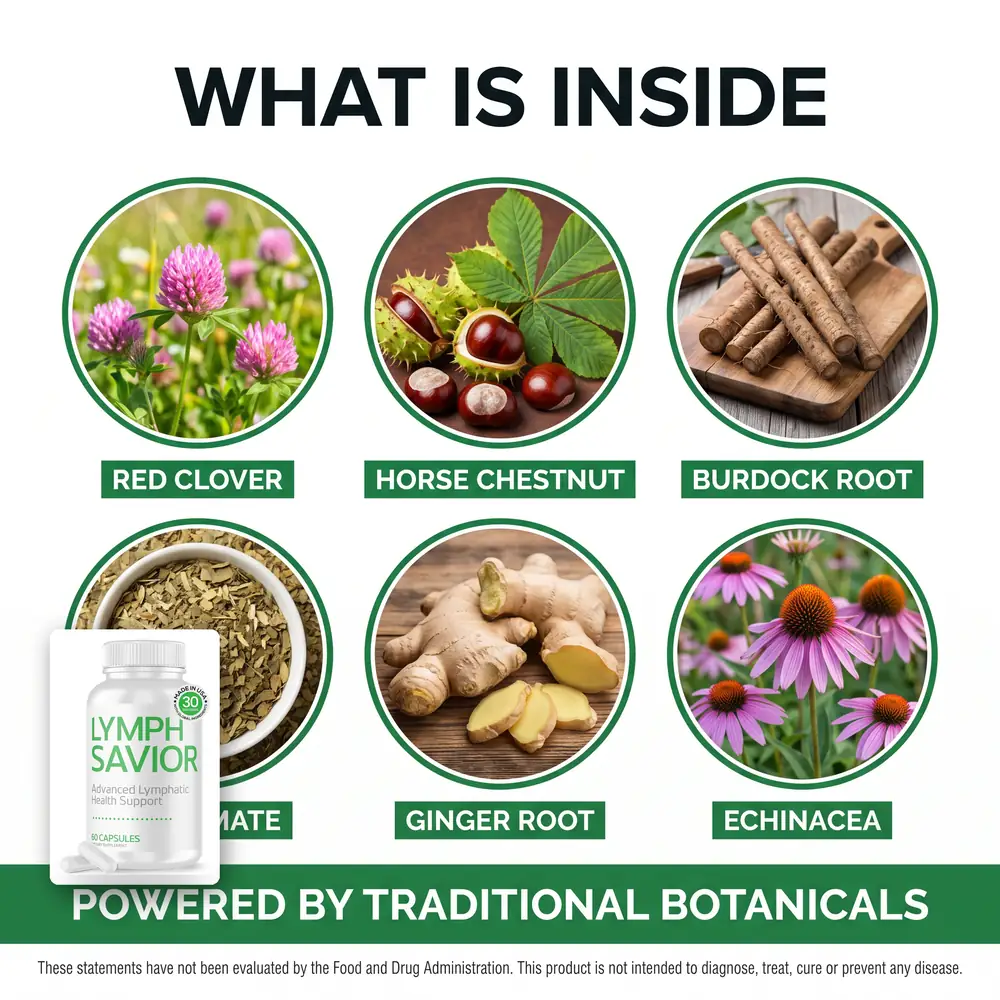
Six botanicals, six plant parts, and the published record for each one set out card by card. The amounts are not there, because the label does not print them.
Four pack sizes, priced at the seller’s checkout, with 180 days from purchase on every one
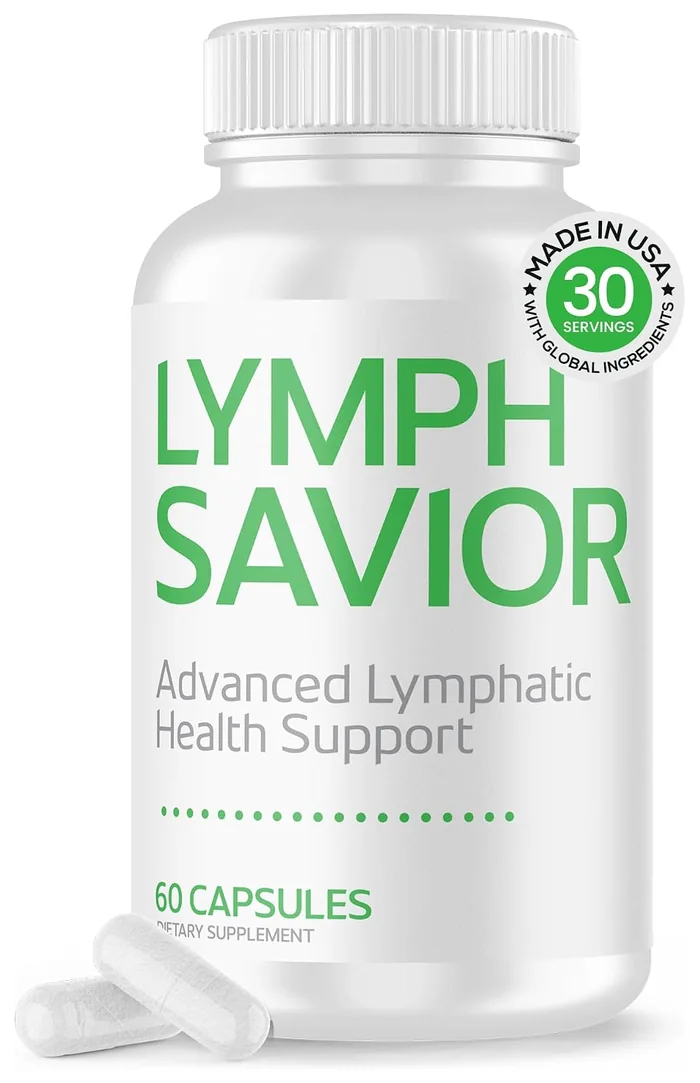
Choose A Lymph Savior PackSwallowed whole, two a day with 6–8 oz of water, 60 to a bottle. Batch LYM-26/LY-5549, shipped from the United States.
Why traditional ingredients keep appearing anyway
There is a commercial reason and there is a better one. The commercial reason is that a name with three hundred years of folk use behind it sounds more convincing on a label than a name with a trial behind it, because most buyers have heard of neither and tradition tells a better story.
The better reason is that the modern evidence base in this area is thin everywhere. The lymphatic system has no pump, moves when you move, and is difficult to measure without imaging. A 2026 review in Ageing Research Reviews describes an area of active interest with very little intervention research attached to it. When there is almost nothing to build a formula from, formulators reach for what herbalists used, and red root is what herbalists used.
The honest way to hold both facts
A traditional ingredient in a modern capsule is neither a scandal nor a credential. What matters is whether the label says which it is. A bottle that implies clinical backing for all six names is misleading; a bottle that names six plants and leaves the reader to look them up is not, provided somebody does the looking. That is what this website is for.
What to do with this before buying anything
Three practical things follow, and none of them is complicated.
- Discount red root to zero when you are working out whether this formula is worth trying. Judge it on the five that have something behind them.
- Ask what the others are standardised to. For horse chestnut seed that question matters more than any other, because NCCIH is explicit that only the standardised extract carries the safety record.
- Use the window rather than the reviews. 180 days from purchase, opened bottles included, is what makes a personal test affordable on a label you cannot fully read.
- Keep walking. Every mechanism on this label sits downstream of movement, and movement is the one intervention nobody has to sell you.
None of that is an argument against buying the product. It is an argument for buying it knowing what is in it, which is a different and more durable position than either enthusiasm or suspicion.
If you want the version of this argument with every source attached, the MedlinePlus page on lymphatic diseases is a good place to start on the system itself, and the ingredients page on this website takes each of the six apart with its literature.
What the folk record actually claims for red root
It is worth being precise about the tradition, because vagueness about it is how a folk claim gets mistaken for a clinical one. The nineteenth-century Eclectic physicians, an American school that leaned heavily on native plants, used Ceanothus americanus root for enlarged lymph nodes, for spleen complaints, and for what they called a torpid lymphatic system. It appears in their dispensatories as a specific, meaning a remedy matched to a particular presentation rather than a general tonic.
Modern Western herbalists inherited that and narrowed it. In contemporary practice red root is described as a lymphatic decongestant, usually given as a tincture, often alongside cleavers and echinacea, and usually for short periods rather than as a daily supplement.
Three things follow from reading the tradition carefully rather than citing it loosely. The traditional preparation is a tincture, not a dried powder in a capsule. The traditional course is short, not indefinite. And the traditional dose is set by a practitioner looking at a person, which is the part a bottle cannot reproduce.
Powder is not tincture
That last distinction matters more than it sounds. An alcohol tincture extracts a different set of compounds from a root than water does, and a dried powder in a capsule delivers the whole root including the parts a tincture leaves behind. A tradition built on one preparation is not automatically evidence for another, even setting aside that the tradition is not evidence in the first place.
How a formulator ends up here
It is easy to read an untested ingredient as cynicism and usually wrong. The more likely story is ordinary.
Someone building a lymphatic formula looks for what the category expects. The category expects red root, because herbalism has said so for two centuries. Two ingredients with real clinical records, horse chestnut seed and Centella, get added because a formulator reading the literature finds them. Red clover joins for the same traditional reason as red root. Burdock and mate round it out. The result is a blend that is half modern and half traditional, which is what almost every product on this shelf turns out to be when you look.
The problem is not the mix. It is that a label listing six names in the same typeface implies the same standing for all six, and nothing on the bottle tells a reader that one of them has never been studied in a person. That information exists, it is free, and it takes a paragraph.
- Pittler MH, Ernst E. Horse chestnut seed extract for chronic venous insufficiency. Cochrane Database Syst Rev. 2012;11(11):CD003230. Seventeen randomised trials: leg pain improved in six of seven placebo-controlled trials, and six trials (n=502) gave a weighted mean leg-volume reduction of 32.1 mL. The review calls the trials suggestive rather than definitive. PMID 23152216. https://pubmed.ncbi.nlm.nih.gov/23152216/
- Chong NJ, Aziz Z. A Systematic Review of the Efficacy of Centella asiatica for Improvement of the Signs and Symptoms of Chronic Venous Insufficiency. Evid Based Complement Alternat Med. 2013;2013:627182. Eight trials; pooled results favoured Centella on microcirculatory measures including ankle swelling rate, with the authors warning that inadequate reporting leaves the risk of bias unclear. PMID 23533507. https://pubmed.ncbi.nlm.nih.gov/23533507/
- Rojas Velazquez MN, Gousopoulos E, Wolf S, et al. Ageing and the lymphatic system: Implications for immunity, brain health, and possible therapeutic interventions. Ageing Res Rev. 2026;118:103126. PMID 41936901. https://pubmed.ncbi.nlm.nih.gov/41936901/
- National Center for Complementary and Integrative Health. Horse Chestnut. States that raw seeds, bark, flowers and leaves are unsafe taken by mouth because they contain a toxic component, that STANDARDISED seed extracts with that component removed are likely safe for short-term use, and that the research record covers up to 12 weeks. https://www.nccih.nih.gov/health/horse-chestnut
- MedlinePlus, U.S. National Library of Medicine. Lymphatic Diseases. Lists the conditions that affect lymph nodes and lymph vessels, and when to have swelling looked at. https://medlineplus.gov/lymphaticdiseases.html