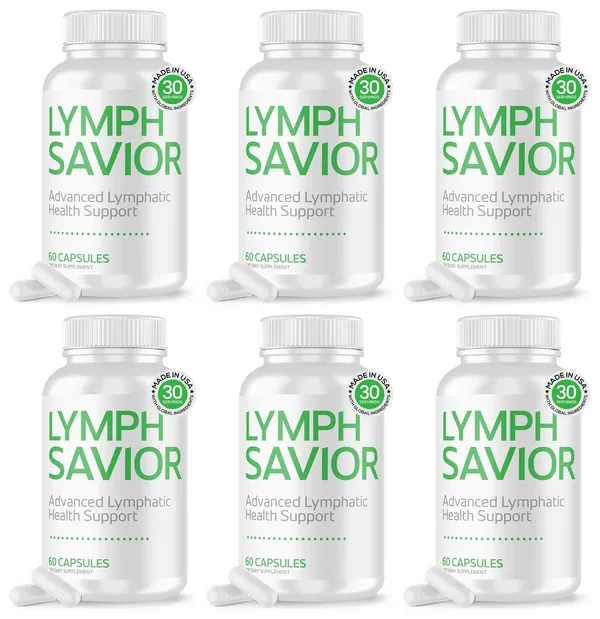
Lymph Savior Official Website › 'Made in USA with global ingredients'
Label literacyThis badge reads 'Made in USA with global ingredients.' Here is what that qualifier legally has to mean.
One of the four badges on the Lymph Savior bottle does not say "Made in USA" on its own. It says "Made in USA with global ingredients," set inside a circular seal alongside a small U.S. flag graphic. That added phrase is not decorative. The Federal Trade Commission, which enforces Made-in-USA labeling under the Section 5 FTC Act and a dedicated 2021 Made in USA Labeling Rule, treats an unqualified "Made in USA" claim and a qualified one like this as two legally different statements with two different evidentiary bars.
An unqualified claim requires that the product be "all or virtually all" made in the United States. A qualified claim like this one is how a company discloses that it does not meet that bar, typically because some raw materials came from outside the country, while still describing a real domestic manufacturing step.
What the unqualified claim requires, what the qualified version on this bottle is disclosing, and how to tell the two apart on any label, not just this one.
The exact words printed on this badge
Four circular badges run along the bottom third of the Lymph Savior bottle art. The first of the four, closest to the Suggested Use text, reads, in full: "Made In USA With Global Ingredients," arranged in a ring around a small American flag icon. It is easy to read that badge the way most shoppers read any flag-and-seal graphic on a bottle: as shorthand for "made in America." The words printed in the ring do not say that. They say something more specific, and the specificity is the entire point of this page.
No other wording appears on this particular badge — no certifying body's name, no reference to a percentage of domestic content, no footnote elsewhere on the bottle elaborating on it. The four words "with global ingredients" are the whole of what the manufacturer discloses about where the product's raw materials come from.
Who enforces Made-in-USA claims, and under what rule
Country-of-origin advertising claims in the United States are regulated by the Federal Trade Commission under Section 5 of the FTC Act, which prohibits unfair or deceptive acts or practices in commerce. For decades the FTC enforced Made-in-USA claims through published guidance known as the "Decision on Enforcement Policy Statement on U.S. Origin Claims." In August 2021, that guidance was converted into a binding regulation, the Made in USA Labeling Rule (16 CFR Part 323), which took effect that same month and gives the FTC authority to seek civil penalties, not just warning letters, for violations. The rule applies to any label, including a dietary supplement bottle, making a claim about U.S. origin.
What an unqualified "Made in USA" claim requires
Under the FTC's standard, an unqualified Made in USA claim — one that simply says "Made in USA" or "American Made" with no further qualifying language — may only be used if the product's "final assembly or processing" occurs in the United States, and all or virtually all of the product's ingredients and processing are of U.S. origin. The FTC's own guidance describes "all or virtually all" as meaning the product contains no, or negligible, foreign content, and that the last substantial transformation of the product also occurred domestically. It is a demanding standard, deliberately so, because the unqualified claim is the strongest, least-hedged version of a country-of-origin statement a company can make.
A company that cannot meet that bar — most commonly because some raw material inputs are sourced internationally, which is extremely common in the botanical-extract supply chain, where specific plants, standardized extracts and even capsule-shell materials are frequently sourced from the country or region where that particular crop or manufacturing capability is concentrated — has two honest options: drop the U.S.-origin claim from the label entirely, or qualify it.
What a qualified claim is for, and why it exists
A qualified Made-in-USA claim adds language that discloses the foreign content or foreign processing a product does contain, rather than claiming none exists. The FTC's own published examples of acceptable qualified claims include phrasing such as "Made in USA of U.S. and imported parts," "60% U.S. content," or similar formulations that tell a reader, in the same breath as the domestic claim, that it is not an "all or virtually all" statement. The rule exists specifically so that a manufacturer with a real but partial domestic manufacturing footprint — final capsule filling and bottling happening in a U.S. facility, for instance, with some botanical raw material sourced from growing regions outside the country — has a truthful way to say so, instead of being forced to choose between an overstated unqualified claim and no origin claim at all.
"Made in USA with global ingredients" is structurally a qualified claim: it names a domestic manufacturing step (Made in USA) and immediately qualifies it with a disclosure about non-domestic inputs (global ingredients), in a single sentence. That structure is consistent with the FTC's own guidance on how a qualifier should be presented — close to the claim it modifies, not buried elsewhere on the package where a reader might see the unqualified half without the qualifying half.
What "with global ingredients" is most likely disclosing here
This page cannot identify, from the printed badge alone, which specific ingredient or ingredients on the Lymph Savior Supplement Facts panel are sourced outside the United States; the label does not break that out ingredient by ingredient, and no public sourcing document for this specific product was located during research for this page. What can be said is narrower: eleven botanicals appear on the panel, several of which — Centella asiatica, a plant native to South and Southeast Asian wetlands, and yerba mate, a plant native to South America, among them — are not commercially grown at meaningful scale within the United States, making international sourcing for at least some raw material in this formula a reasonable inference even without a specific breakdown. Whether the final capsule-filling, encapsulation and bottling occurred domestically is a separate question this badge answers in the affirmative ("Made in USA") while the ingredient sourcing question is answered by the qualifier ("with global ingredients").
It is worth noting what this page is deliberately not concluding from that inference. Botanical raw-material sourcing from outside the United States is not, by itself, a quality concern or a safety concern; it is simply a supply-chain fact, true of a large share of the global botanical-supplement industry regardless of brand, because a great many medicinal and culinary plants are concentrated in specific growing regions for reasons of climate and agricultural tradition that have nothing to do with the finished product's manufacturing quality. The qualifier on this badge is a disclosure about geography, not a disclosure about quality control, and conflating the two would be reading a claim into the badge that its own wording does not make.
Four other label statements, and which bucket each falls in
| Printed statement | Type of claim | What it actually requires |
|---|---|---|
| "Made In USA With Global Ingredients" | Qualified country-of-origin claim | Discloses non-U.S. ingredient sourcing; does not require "all or virtually all" domestic content, unlike an unqualified claim |
| "Scientific Formulated" | General marketing statement | Not a regulated or defined term; no specific testing or formulation standard attaches to this phrase |
| "GMPc Facility" | Regulatory-process reference | References 21 CFR Part 111, a binding federal manufacturing regulation, discussed in full on a separate page of this journal |
| "Made With Non-GMO Ingredients" | Voluntary ingredient claim | Not independently certified on this label; no third-party Non-GMO Project or similar verification mark appears beside it |
Of the four badges on this bottle, the Made in USA badge is the one most directly governed by a specific, binding FTC rule with defined legal standards for both the qualified and unqualified versions of the claim.
What happens when a company gets this wrong
The 2021 rule gave the FTC meaningfully sharper teeth than it had under the older enforcement-policy guidance it replaced. Before 2021, a company that printed an unsupported unqualified "Made in USA" claim typically faced an administrative consent order requiring it to stop; there was no direct path to a civil monetary penalty for a first violation. Under the current Made in USA Labeling Rule, the FTC can seek civil penalties directly through federal court action, and in the years since the rule took effect the agency has brought several enforcement actions against companies, across product categories well beyond supplements, that used an unqualified "Made in USA" claim without meeting the "all or virtually all" standard the rule sets.
That enforcement history is the practical reason a qualifier like "with global ingredients" matters commercially, not just rhetorically: it is very plausibly the difference between a label a company can defend if the FTC asks it to, and one it cannot. A manufacturer choosing to print the qualified version, rather than risk an unqualified claim it could not support, is making a specific legal decision, not an arbitrary wording choice.
How to read a qualifier like this on any label
The broader habit this specific badge illustrates is worth carrying past this one product. A country-of-origin claim that includes any qualifying language — "with imported ingredients," "with global ingredients," "assembled in USA from domestic and imported parts," or similar — is, by FTC rule, a different and weaker claim than the unqualified version of the same phrase, even though the two can look nearly identical on a crowded label. The qualifier is not fine print to be skimmed past; under the regulation that governs it, the qualifier is the operative part of the sentence.
- An unqualified "Made in USA" is a strong claim: all or virtually all domestic content and processing.
- A qualified claim like this one is a disclosure, not a loophole: it is the FTC-compliant way to describe a product with a real domestic manufacturing step and some non-domestic raw material.
- Neither version, qualified or unqualified, makes any claim about efficacy, potency, or the amounts printed on the Supplement Facts panel above it. Country of origin and ingredient quantity are two separate questions, answered by two separate parts of the label.
There is a second habit worth building alongside the first: noticing when a label's other badges are, by contrast, unqualified and undefined. "Scientific Formulated," elsewhere on this same bottle, carries no regulation behind it at all — no federal rule defines what "scientific" formulation requires, no agency enforces the phrase, and no qualifier would even be meaningful on it, because there is no baseline claim being narrowed. Setting that badge beside the Made in USA badge on the same bottle is a useful exercise precisely because the two look like members of the same badge family while sitting on opposite ends of how tightly regulated their wording is: one answers to a specific federal rule with defined legal consequences for getting it wrong, and the other answers to nothing but the company's own marketing department.
That contrast is the practical skill this page is really arguing for. A badge wall on a supplement bottle reads, at a glance, like a uniform set of credentials, four seals of roughly equal weight arranged in a single row. Read closely, each badge sits on its own separate legal footing — some backed by a binding federal rule with a documented enforcement history and real financial consequences for a false claim, others backed by nothing more than the manufacturer's own say-so and a well-designed circular graphic — and it is the words printed inside each seal, not its shape, its color, or its position in the row, that actually determine which kind of claim a reader is looking at.
- Federal Trade Commission. Made in USA Labeling Rule, 16 CFR Part 323 (effective August 13, 2021). Defines the "all or virtually all" standard for unqualified claims and the disclosure standard for qualified claims, with enforcement authority including civil penalties. https://www.ftc.gov/business-guidance/resources/complying-made-usa-standard
- Federal Trade Commission. Complying with the Made in USA Standard. FTC's plain-language business guidance explaining qualified versus unqualified claims with worked examples. https://www.ftc.gov/business-guidance/resources/complying-made-usa-standard